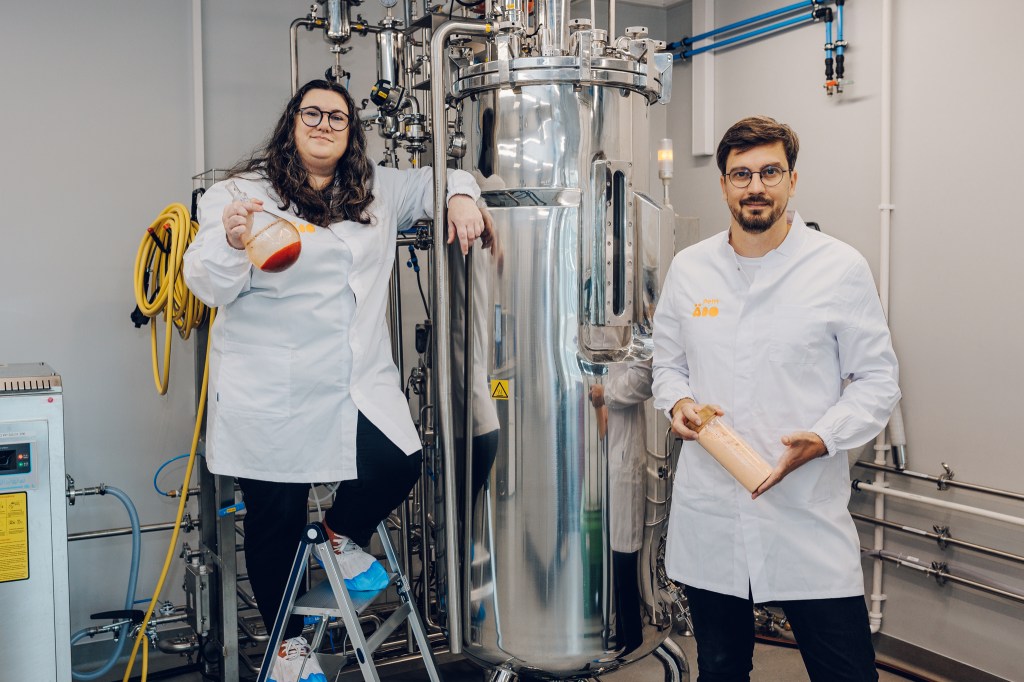
Äio (pronounced EYE-oh) is the Estonian god of dreams. It seems a sweetly appropriate namesake for a rising startup, called ÄIO, from that tiny Baltic country that has developed a process to turn agricultural waste like sawdust into fats for the food and cosmetic industries.
This process could be a way to reduce the world’s dependency on palm oil, which has become a staple for food and cosmetics for its emulsifying and preservative properties. Unfortunately, because of that plant’s need for hot humid climates, this massive industry has also notoriously destroyed rain forests and other sensitive ecosystems to make way for farms.
ÄIO was co-founded by biotechnology scientists Nemailla Bonturi and Petri-Jaan Lahtvee based on Bonturi’s doctoral research. During her studies she invented a new microbe, a strain of yeast. Instead of consuming sugar and outputting carbon dioxide gas or alcohol as with bread and beer, this yeast consumes sugar and outputs fat molecules. The company will show off its tech as part of Startup Battlefield at this year’s TechCrunch Disrupt, which runs later this month in San Francisco.
Lahtvee was a professor of Food Tech and Bioengineering at Estonia’s Tallinn University of Technology and, in 2016, running his own biotech lab there with Bonturi, his first hire. She brought her microbe with her, and they worked on the molecule, altering it to be hardy enough to be manufactured.
As Estonia has a large agriculture base of corn and other food grains, as well as sugarcane and lumber, the lab studied how sugars produced from those ag waste streams could feed this microbe. “We started working on it, developing metabolic engineering tools,” Lahtvee told TechCrunch. The answer: It could consume those sugars quite well.
The molecule’s “fat profile is very similar to existing fats,” Lahtvee says, and, in its solid-fat form, probably “most closely resembles chicken fat.” But it is also possible to modify the fermentation process to produce a liquid oil as well that could make it a good alternative to manufactured oils like canola/rapeseed oil.
In 2022, the founders knew they had a commercially viable solution and launched ÄIO with the hope of raising venture money and establishing commercial partnerships to bring it to market. They’ve raised about $7 million so far and, since founding, have created methods for developing precision fermentation products, won the 2024 Baltic Sustainability Award, and signed over 100 companies worldwide interested in collaboration, the startup says.
Disrupt 2026: The tech ecosystem, all in one room
Your next round. Your next hire. Your next breakout opportunity. Find it at TechCrunch Disrupt 2026, where 10,000+ founders, investors, and tech leaders gather for three days of 250+ tactical sessions, powerful introductions, and market-defining innovation. Register now to save up to $400.
Save up to $300 or 30% to TechCrunch Founder Summit
1,000+ founders and investors come together at TechCrunch Founder Summit 2026 for a full day focused on growth, execution, and real-world scaling. Learn from founders and investors who have shaped the industry. Connect with peers navigating similar growth stages. Walk away with tactics you can apply immediately
Offer ends March 13.
“We have a very extensive analysis after we make our product and, so far, what we have seen is that our final product is to the same level as vegetable oils, except for the pesticides — even more pure,” Bonturi told TechCrunch.
Next up, the company plans to build a facility to produce the fat in commercial quantities by 2027, as well as license the technology to other cosmetic and food manufacturers. It also must obtain licenses to sell the fats as food, country by country, most likely starting with Singapore, which has a history of being more open to alternative food production products.
“Of course, it’s a novel type of way of producing food, and we have to go through all the permits and analysis,” Bonturi said.
As such plans progress, Bonturi said that she hopes to show how “two scientists in this small country could actually do something better for the world, but that’s just my personal dream.”
If you want to learn more about ÄIO from the company itself — while also checking out dozens of others, hearing their pitches, and listening to guest speakers on four different stages — join us at Disrupt, October 27 to 29, in San Francisco. Learn more here.