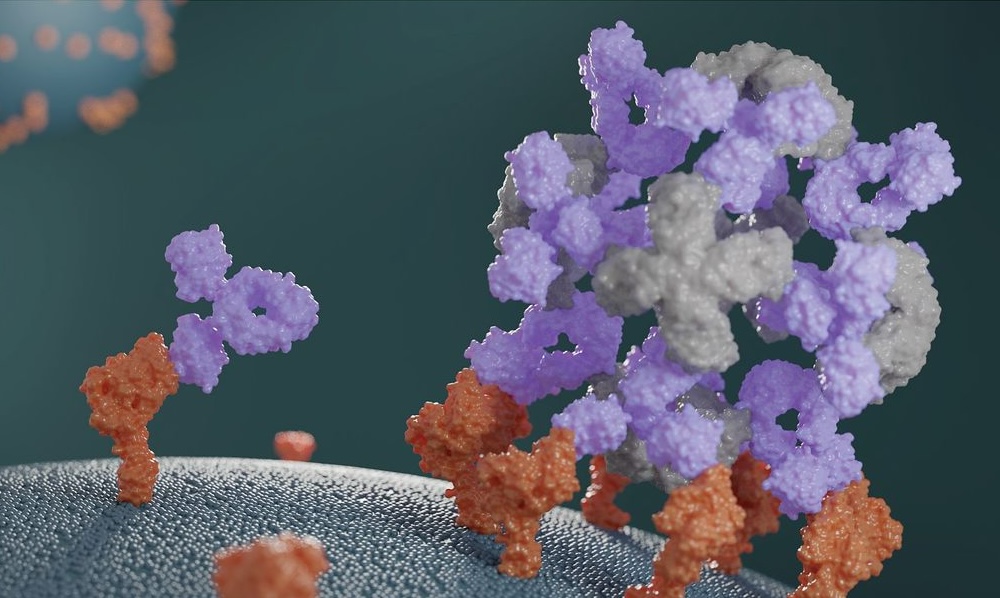
Archon Biosciences, a biotech startup putting AI to work designing novel biomolecules, has just emerged from stealth with an impressive $20 million in seed funding. The company aims to supercharge antibody treatments using specially designed protein “cages” that multiply their effects, opening up new opportunities in drug development.
The company was spun out of Baker Lab, the University of Washington research outfit overseen by pioneering computational biologist and recent Nobel Prize winner David Baker. His team’s work on generative protein design using AI and other means has been foundational in the fast-evolving industry, and Archon is taking a specific aspect of it to market.
One shortcoming of antibody treatments (and research into effective treatments) is that, like all molecular biology, the process depends a bit on chance. It’s difficult to control how much an antibody or protein actually binds to its target on a cell or other surface.
What Archon’s antibody cages, or AbCs, do (as documented in this paper published in Science) is offer a scaffold for modifying and multiplying their effectiveness. A free-floating antibody may have only a small chance of binding to a target protein, but if you were to stick a dozen of them together in a big dodecahedron, that significantly and perhaps profoundly improves that chance.
This may be the difference between being able to tell if a medication works or not.
“There are many high-profile cases where we understand not only a target’s biology but also why past attempts to drug the target have failed in the clinic. These key disease levers are at our fingertips, but we lack the tools to safely and effectively engage them,” explained James Lazarovits, co-founder and CEO of Archon, in a press release. “We have developed a proprietary protein design platform coupled with rapid in-house manufacturing and testing to revolutionize how biologics are developed.”
The startup’s protein design platform uses the generative protein creation and simulation tools created at and licensed from Baker Lab, and the resulting AbCs could have a variety of effects. And they don’t need any exotic manufacturing methods — if you can produce proteins and antibodies at scale, you can probably make AbCs too.
Disrupt 2026: The tech ecosystem, all in one room
Your next round. Your next hire. Your next breakout opportunity. Find it at TechCrunch Disrupt 2026, where 10,000+ founders, investors, and tech leaders gather for three days of 250+ tactical sessions, powerful introductions, and market-defining innovation. Register now to save up to $400.
Save up to $300 or 30% to TechCrunch Founder Summit
1,000+ founders and investors come together at TechCrunch Founder Summit 2026 for a full day focused on growth, execution, and real-world scaling. Learn from founders and investors who have shaped the industry. Connect with peers navigating similar growth stages. Walk away with tactics you can apply immediately
Offer ends March 13.
The $20 million round was led by Madrona Ventures with participation from DUMAC Inc., Sahsen Ventures, WRF Capital, Pack Ventures, Alexandria Venture Investments, and Cornucopian Capital; it comes on top of some $7 million in grants from a number of institutes and government agencies.
Archon is, like UW and Baker Lab, based in Seattle. TechCrunch will be visiting soon to learn and share more about this promising spinout.