

The entire Internet (aka Facebook, Google, Apple AOL, Facebook, eBay, Netflix, Office Depot, OfficeMax, Staples, Yahoo, and YouTube) has just been served with a vague and vast patent violation suit from Microsoft’s co-founder Paul Allen. As patent suits are notoriously unpopular, the response from tech pundits has been apprehensive. Now the companies named are starting to punch back, a representative from Facebook told TechCrunch, “We believe this suit is completely without merit and we will fight it vigorously.”
A representative from Google also commented on the validity of the suit.
“This lawsuit against some of America’s most innovative companies reflects an unfortunate trend of people trying to compete in the courtroom instead of the marketplace. Innovation — not litigation — is the way to bring to market the kinds of products and services that benefit millions of people around the world.”
According to the WSJ, “Mr. Allen, a pioneer of computer software, didn’t develop any of the technology himself but owns the patents.”
In the suit, Interval Licensing LLC, a company owned by Allen, lists violations of four decade old patents (6,263,507, 6,034,652, 6,788,314, 6,757,682) that seem to cover basic operations of almost any Internet company including Google, Facebook and Microsoft — who unsurprisingly is not listed by Allen as a defendant — especially patent #657. It also seems as though patents #657 and #314 are exactly the same.
- Patent #507 “Browser for Use in Navigating a Body of Information, With Particular Application to Browsing Information Represented By Audiovisual Data.”
- Patent #657 “Attention Manager for Occupying the Peripheral Attention of a Person in the Vicinity of a Display Device.”
- Patent #314 “Attention Manager for Occupying the Peripheral Attention of a Person in the Vicinity of a Display Device.”
- Patent #682 “Alerting Users to Items of Current Interest.”
“Defendant Facebook has infringed and continues to infringe one or more claims of the ’682 patent. Facebook is liable for infringing the ’682 patent under 35 U.S.C. § 271 by making and using websites and associated hardware and software to provide alerts that information is of current interest to a user as claimed in the patent.”
Techcrunch eventDisrupt 2026: The tech ecosystem, all in one room
Your next round. Your next hire. Your next breakout opportunity. Find it at TechCrunch Disrupt 2026, where 10,000+ founders, investors, and tech leaders gather for three days of 250+ tactical sessions, powerful introductions, and market-defining innovation. Register now to save up to $400.
Save up to $300 or 30% to TechCrunch Founder Summit
1,000+ founders and investors come together at TechCrunch Founder Summit 2026 for a full day focused on growth, execution, and real-world scaling. Learn from founders and investors who have shaped the industry. Connect with peers navigating similar growth stages. Walk away with tactics you can apply immediately
Offer ends March 13.San Francisco, CA | October 13-15, 2026“Defendant Google has infringed and continues to infringe one or more claims of the ’682 patent. Google is liable for infringing the ’682 patent under 35 U.S.C. § 271 by making and using websites and associated hardware and software to provide alerts that information is of current interest to a user as claimed in the patent.”
Earlier this month TechCrunch’s Vivek Wadha wrote about why patents in the technology industry are somewhat absurd.
“But in software these are just nuclear weapons in an arms race. They don’t foster innovation, they inhibit it. That’s because things change rapidly in this industry. Speed and technological obsolescence are the only protections that matter. Fledgling startups have to worry more about some big player or patent troll pulling out a big gun and bankrupting them with a frivolous lawsuit than they do about someone stealing their ideas.”
Paul Allen might have just provided us with the most extreme proof of Wadha’s argument yet.
Update: The WSJ’s Jennifer Valentino-DeVries has a closer look at the Interval Licensing patents, illustrated.
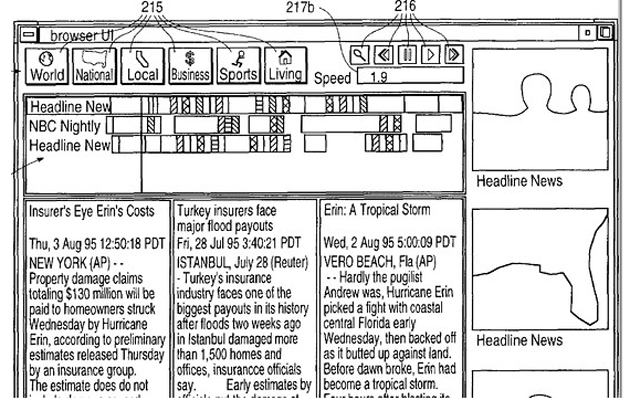
Image: jr11223344


