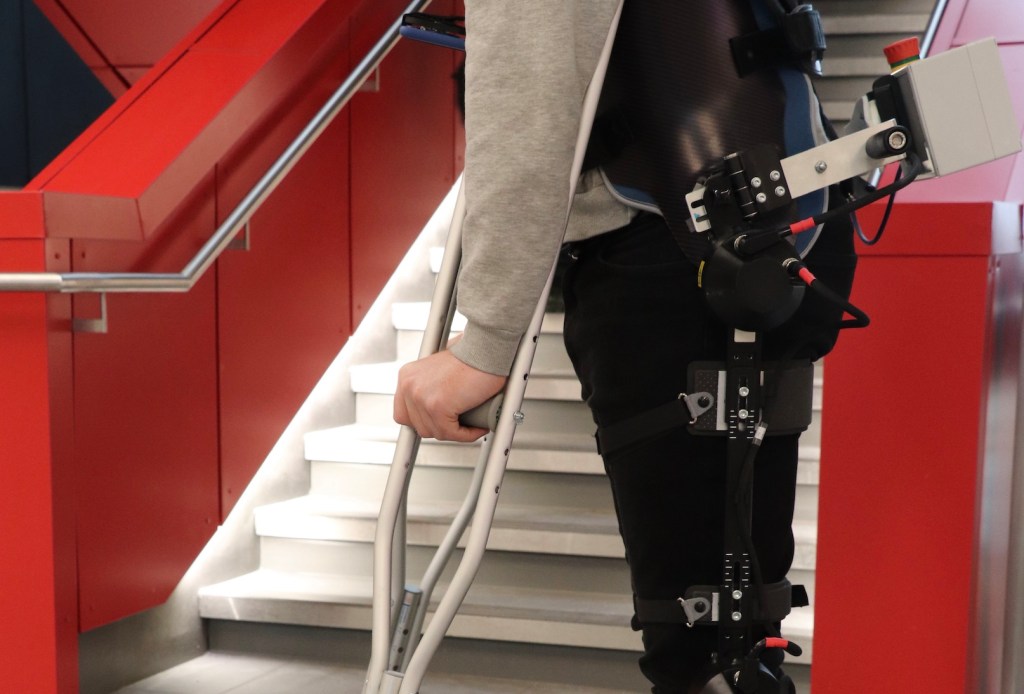
Researchers at Canada’s University of Waterloo are showcasing work with prostheses and exoskeletons that utilizes cameras and AI to deliver more natural human movement. The ExoNet project leverages video captured by a wearable camera, run through deep learning AI, in order to mimic how humans adapt and adjust movements based on their environments.
The project is an attempt to create more natural locomotion on the fly than is currently offered through systems with connected smartphone apps or other external controllers.
“That can be inconvenient and cognitively demanding,” Waterloo PhD candidate Brokoslaw Laschowski said in a release tied to the research. “Every time you want to perform a new locomotor activity, you have to stop, take out your smartphone and select the desired mode.”
The research highlighted primarily focuses on robotic exoskeletons, which are being developed by a number of different companies to help assist people with impaired mobility. The hope here is that the ExoNet system could eventually replace the need for external control by the wearer in order to create more natural locomotion.
R&D Roundup: Ultrasound/AI medical imaging, assistive exoskeletons and neural weather modeling
Of course, there’s still a lot of work to be done. Naturally, the system is easier to navigate on flat terrain. Next steps would involve adapting it to environments that tend to give those with limited mobility some difficulty, including stairs and other obstacles. A final version of the system would be able to anticipate and adapt accordingly.
Disrupt 2026: The tech ecosystem, all in one room
Your next round. Your next hire. Your next breakout opportunity. Find it at TechCrunch Disrupt 2026, where 10,000+ founders, investors, and tech leaders gather for three days of 250+ tactical sessions, powerful introductions, and market-defining innovation. Register now to save up to $400.
Save up to $300 or 30% to TechCrunch Founder Summit
1,000+ founders and investors come together at TechCrunch Founder Summit 2026 for a full day focused on growth, execution, and real-world scaling. Learn from founders and investors who have shaped the industry. Connect with peers navigating similar growth stages. Walk away with tactics you can apply immediately
Offer ends March 13.
“Our control approach wouldn’t necessarily require human thought,” Laschowski adds. “Similar to autonomous cars that drive themselves, we’re designing autonomous exoskeletons that walk for themselves.”
There are other challenges here, as well. Batteries are an issue, for one. The team is looking to improve longevity by experimenting with a system that can recharge with the wearer’s movement.
Robotic exoskeletons promise increased mobility and job assistance