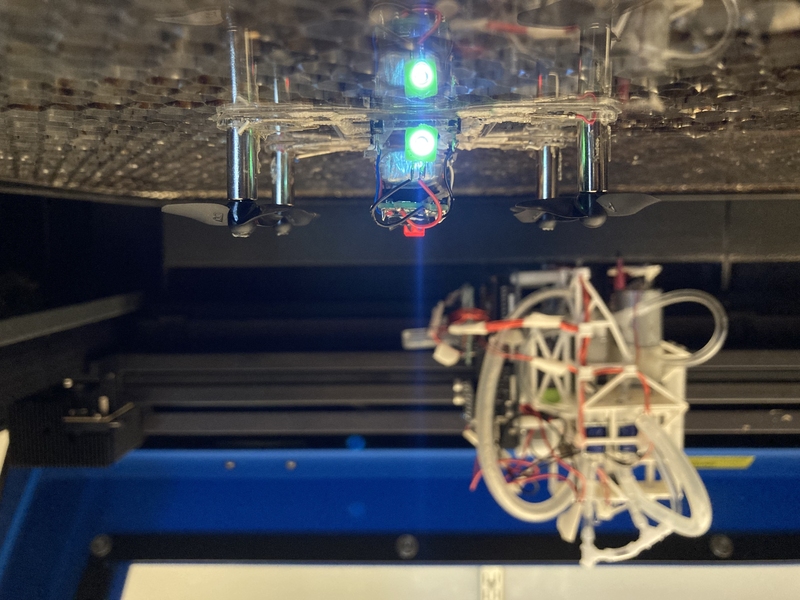
Additive manufacturing has proven an ideal solution for certain tasks, but the technology still lacks more traditional methods in a number of categories. One of the biggest is the requirement for post-printing assembly. 3D printers can create extremely complex components, but an outside party (be it human or machine) is required to put them together.
MIT’s CSAIL department this week showcased “LaserFactory,” a new project that attempts to develop robotics, drones and other machines than can be fabricated as part of a “one-stop shop.” The system is comprised of a software kit and hardware platform designed to create structures and assemble circuitry and sensors for the machine.
A more fully realized version of the project will be showcased at an event in May, but the team is pulling back the curtain a bit to show what the concept looks like in practice. Here’s a breakdown from CSAIL’s page:
Let’s say a user has aspirations to create their own drone. They’d first design their device by placing components on it from a parts library, and then draw on circuit traces, which are the copper or aluminum lines on a printed circuit board that allow electricity to flow between electronic components. They’d then finalize the drone’s geometry in the 2D editor. In this case, they’d use propellers and batteries on the canvas, wire them up to make electrical connections, and draw the perimeter to define the quadcopter’s shape.
Printing circuit boards is certainly nothing new. What sets CSAIL’s machine apart here is the breadth of functionality that’s been jammed into the machine here. An accompanying video lays it out pretty well:
Of course, this is early days — we’re still months out from the official presentation. There are a lot of questions, and more to the point, a lot of potential points of failure for a complex machine like this — especially one that seems to have non-experts as a target audience.
Disrupt 2026: The tech ecosystem, all in one room
Your next round. Your next hire. Your next breakout opportunity. Find it at TechCrunch Disrupt 2026, where 10,000+ founders, investors, and tech leaders gather for three days of 250+ tactical sessions, powerful introductions, and market-defining innovation. Register now to save up to $400.
Save up to $300 or 30% to TechCrunch Founder Summit
1,000+ founders and investors come together at TechCrunch Founder Summit 2026 for a full day focused on growth, execution, and real-world scaling. Learn from founders and investors who have shaped the industry. Connect with peers navigating similar growth stages. Walk away with tactics you can apply immediately
Offer ends March 13.
“Making fabrication inexpensive, fast, and accessible to a layman remains a challenge,” PhD student and lead author Martin Nisser says in the release. “By leveraging widely available manufacturing platforms like 3D printers and laser cutters, LaserFactory is the first system that integrates these capabilities and automates the full pipeline for making functional devices in one system.”
The software appears to be a big piece of the puzzle — allowing users to view a version of the product before it’s printed. By then, of course, it’s too late.