
Getaway CEO Jon Staff said that while the startup’s offerings weren’t designed with a pandemic in mind, they turned out to be well-suited for a time when people were eager to find safe ways to get off Zoom and out of their homes.
Founded in 2015, Getaway builds “Outposts” — collections of tiny cabins in rustic locations within a two-hour drive of major cities like Atlanta, Austin, Los Angeles and New York. Those cabins sound perfect for socially distanced retreats, with guests checking themselves in, each cabin built with its own fire pit and spaced 50 to 150 feet from the others, with no common areas.
Staff told me that rather than promoting traditional tourist activities, Getaway emphasizes disconnecting from all the stresses and distractions of modern life. So its cabins don’t include Wi-Fi, and they also have lockboxes where visitors can hide their phones for the duration of their visits.
“We try to get you to do nothing, quite literally,” he said. “How few moments are there in life when you really have enough free time that you could do nothing? And if not nothing, have a deep conversation with your partner, or take the time to cook a good meal and really enjoy the experience with people who are there sitting next to the campfire with you?”
Staff acknowledged that some investors were skeptical about Getaway’s insistence on building the cabins and Outposts itself. He recalled talking to tech-focused venture capitalists who would ask, “Why isn’t this a platform? Why isn’t it going to be worth $1 billon a year from now?” while potential investors from the real estate world would want to know, “How tall of a skyscraper do you want to build?”
“For a while, I had this anxiety that we don’t fit in any box,” he said. “But I learned to appreciate the benefits of not fitting in any box — that’s where innovation really lies.”
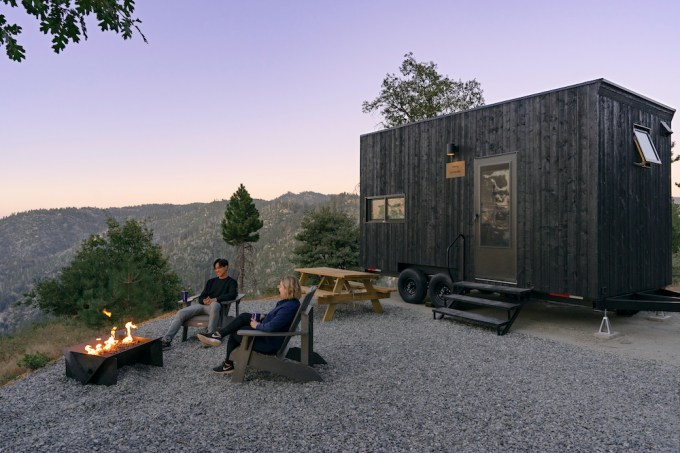
And the Getaway approach seemed to resonate in 2020, with bookings increasing 150% year-over-year and the startup’s Outposts operating at nearly 100% occupancy. Today it’s announcing that it has raised $41.7 million in Series C funding — first revealed in a regulatory filing and led by travel and hospitality-focused firm Certares.
Disrupt 2026: The tech ecosystem, all in one room
Your next round. Your next hire. Your next breakout opportunity. Find it at TechCrunch Disrupt 2026, where 10,000+ founders, investors, and tech leaders gather for three days of 250+ tactical sessions, powerful introductions, and market-defining innovation. Register now to save up to $400.
Save up to $300 or 30% to TechCrunch Founder Summit
1,000+ founders and investors come together at TechCrunch Founder Summit 2026 for a full day focused on growth, execution, and real-world scaling. Learn from founders and investors who have shaped the industry. Connect with peers navigating similar growth stages. Walk away with tactics you can apply immediately
Offer ends March 13.
Getaway plans to use the funding to expand to at least 17 Outposts this year, up from 12 in 2020 and nine in 2019. The startup has now raised more than $81 million in total funding, according to Crunchbase.
Staff said that eventually, Getaway could also add other products and services, because, “The brand is not about tiny houses or tiny cabins, the brand is about [the fact that] the world is too noisy and too connected over the long haul. Getaway could be doing other things to solve that problem.”
At the same time, he said it’s crucial to remain clear and focused on the experience that Getaway wants to provide.
“We always try to remind ourselves that we are not creating the experience at Getaway,” he said. “You’re creating the experience and, if we’re doing it well, we’re facilitating it, we’re giving you everything you need and nothing you don’t … There’s a lot of freedom to make of it what you want as the guest, but there are also boundaries.”
For example, Staff said that there have been requests to offer Getaway Outposts for work retreats, but that’s not what they’re designed for: “We’re not going to police it, but we’re not going to put in Wi-Fi.”
Where top VCs are investing in travel, tourism and hospitality tech