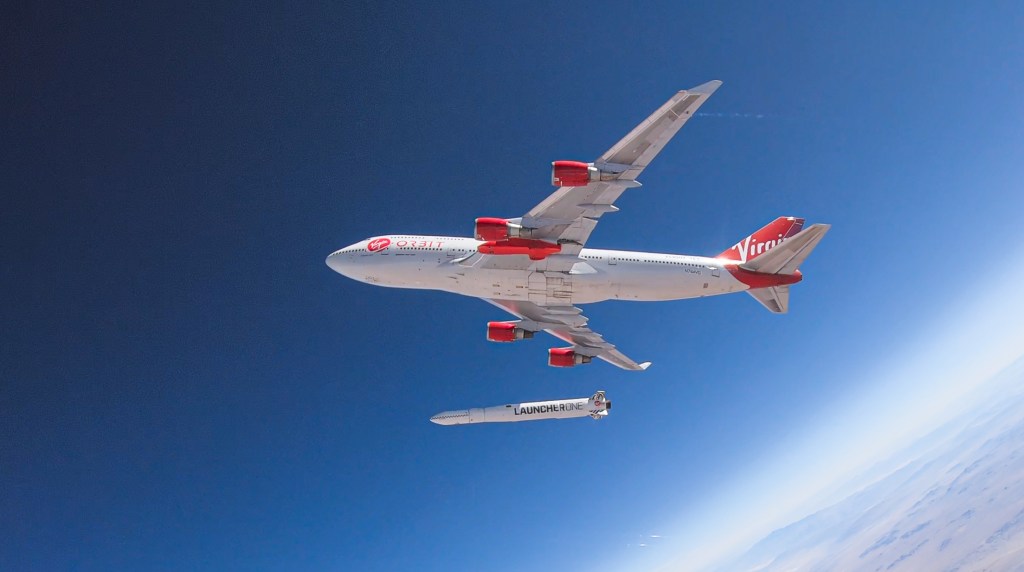
Virgin Orbit launched its LauncherOne rocket to orbit for the first time today, with a successful demonstration mission that carried a handful of satellites and delivered them successfully to low-Earth orbit on behalf of NASA. It’s a crucial milestone for the small satellite launch company, and the first time the company has shown that its hybrid carrier aircraft/small payload orbital delivery rocket works as intended, which should set the company up to begin commercial operations of its launch system very soon.
This is the second attempt at reaching orbit for Virgin Orbit, after a first try in late May ended with the LauncherOne rocket initiating an automatic safety shutdown of its engines shortly after detaching from the “Cosmic Girl” carrier aircraft, a modified Boeing 747 that transports the rocket to its launch altitude. The company said that it learned a lot from that attempt, including identifying the error that caused the failsafe engine shut down, which it corrected in advance of today’s mission.
Virgin Orbit’s first orbital test flight cut short after rocket released from carrier aircraft
Virgin’s Cosmic Girl took off at just before 2 p.m. EST, and then released LauncherOne from its wing at roughly 2:40 p.m. EST. LauncherOne had a “clean separation” as intended, and then ignited its own rocket engines and quickly accelerated to the point where it was undergoing the maximum amount of aerodynamic pressure (called max q in the aerospace industry). LauncherOne’s main engine then cut off after its burn, and its payload stage separated, crossing the Karman line and entering space for the first time.
It achieved orbit at around 2:49 p.m. EST and released its payload of satellites to their target orbit sometime later on schedule, making the mission a complete success.
Virgin Orbit’s unique value proposition in the small launch market is that it can take off and land from traditional runways thanks to its carrier aircraft and midair rocket launch approach. That should provide flexibility in terms of launch locations, allowing it to be more responsive to customer needs in terms of geographies and target orbital deliveries.
Disrupt 2026: The tech ecosystem, all in one room
Your next round. Your next hire. Your next breakout opportunity. Find it at TechCrunch Disrupt 2026, where 10,000+ founders, investors, and tech leaders gather for three days of 250+ tactical sessions, powerful introductions, and market-defining innovation. Register now to save up to $400.
Save up to $300 or 30% to TechCrunch Founder Summit
1,000+ founders and investors come together at TechCrunch Founder Summit 2026 for a full day focused on growth, execution, and real-world scaling. Learn from founders and investors who have shaped the industry. Connect with peers navigating similar growth stages. Walk away with tactics you can apply immediately
Offer ends March 13.
In 2017, Virgin Orbit was spun out of Virgin Galactic, to focus exclusively on small payload orbital launch. Virgin Galactic then devoted itself entirely to its own mission of offering commercial human spaceflight. Virgin Orbit itself create its own subsidiary earlier this year, called VOX Space, which intends to use LauncherOne to deliver small satellites to orbit specifically for the U.S. national security market.