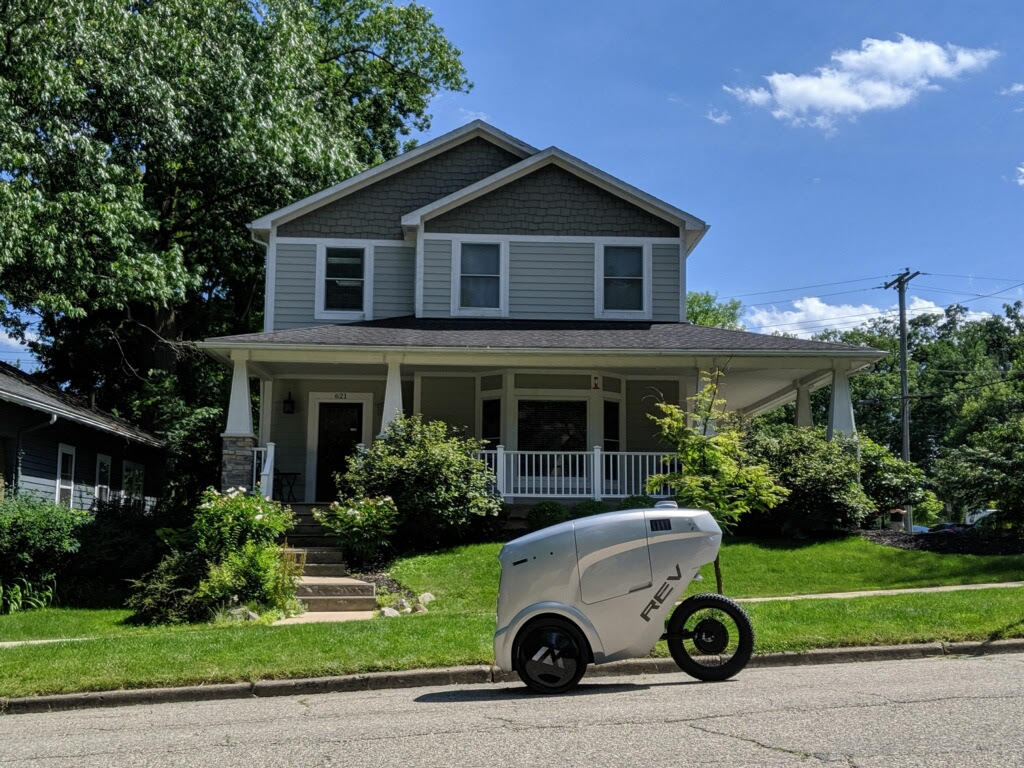
Refraction, a new autonomous delivery robot company that came out of stealth Wednesday at TC Sessions: Mobility, sees opportunity in areas most AV startups are avoiding: regions with the worst weather.
The company, founded by University of Michigan professors Matthew Johnson-Roberson and Ram Vasudevan, calls its REV-1 delivery robot the “Goldilocks of autonomous vehicles.”
The pair have a long history with autonomous vehicles. Johnson-Roberson got his start by participating in the DARPA Grand Challenge in 2004 and stayed in academia researching and then teaching robotics. Vasudevan’s career had a stint at Ford working on control algorithms for autonomous operations on snow and ice. Both work together at University of Michigan’s Robotics Program.
The REV-1 is lightweight and low cost — there are no expensive lidar sensors on the vehicle — it operates in a bike lane and is designed to travel in rain or snow, Johnson-Roberson, co-founder and CEO of Refraction told TechCrunch.
The robot, which debuted onstage at the California Theater in San Jose during the event, is about the size of an electric bicycle. The REV-1 weighs about 100 pounds and stands about 5 feet tall and is 4.5 feet long. Inside the robot is 16 cubic feet of space, enough room to fit four or five grocery bags.
It’s not particularly fast — top speed is 15 miles per hour. But because it’s designed for a bike lane, it doesn’t need to be. That slower speed and lightweight design allows the vehicle to have a short stopping distance of about five feet.
Refraction has backing from eLab Ventures and Trucks Venture Capital.
Disrupt 2026: The tech ecosystem, all in one room
Your next round. Your next hire. Your next breakout opportunity. Find it at TechCrunch Disrupt 2026, where 10,000+ founders, investors, and tech leaders gather for three days of 250+ tactical sessions, powerful introductions, and market-defining innovation. Register now to save up to $400.
Save up to $300 or 30% to TechCrunch Founder Summit
1,000+ founders and investors come together at TechCrunch Founder Summit 2026 for a full day focused on growth, execution, and real-world scaling. Learn from founders and investors who have shaped the industry. Connect with peers navigating similar growth stages. Walk away with tactics you can apply immediately
Offer ends March 13.
Consumers have an appetite and an expectation for on-demand goods that are delivered quickly. But companies are struggling to find consistent, reliable and economical ways to address that need, said Bob Stefanski, managing director of eLab Ventures.
Stefanksi believes Refraction’s sturdy, smaller-sized delivery robots will allow for faster technology development and will be able to cover a larger service area than competitors operating on the sidewalk.
“Their vehicles are also lightweight enough to deploy more safely than a self-driving car or large robot,” Stefanski noted. “The market is huge, especially in densely populated areas.”
The REV-1 uses a system of 12 cameras as its primary sensor system, along with radar and ultrasound sensors for additional safety.
“It doesn’t make sense economically speaking to use a $10,000 lidar to deliver $10 of food,” Johnson-Roberson said. By skipping the more expensive lidar sensor, they’re able to keep the total cost of the vehicle to $5,000.
The company’s first test application is with local restaurant partners. The company hopes to lock in bigger national partnerships in the next six months. But don’t expect those to be in the southwest or California, where so many other autonomous vehicle companies are testing.
“Other companies are not trying to run in the winter here,” Johnson-Roberson said. “It’s a different problem than the one that others are trying to solve, so we hope that gives us some space to breathe and some chance to carve out some opportunity.”