

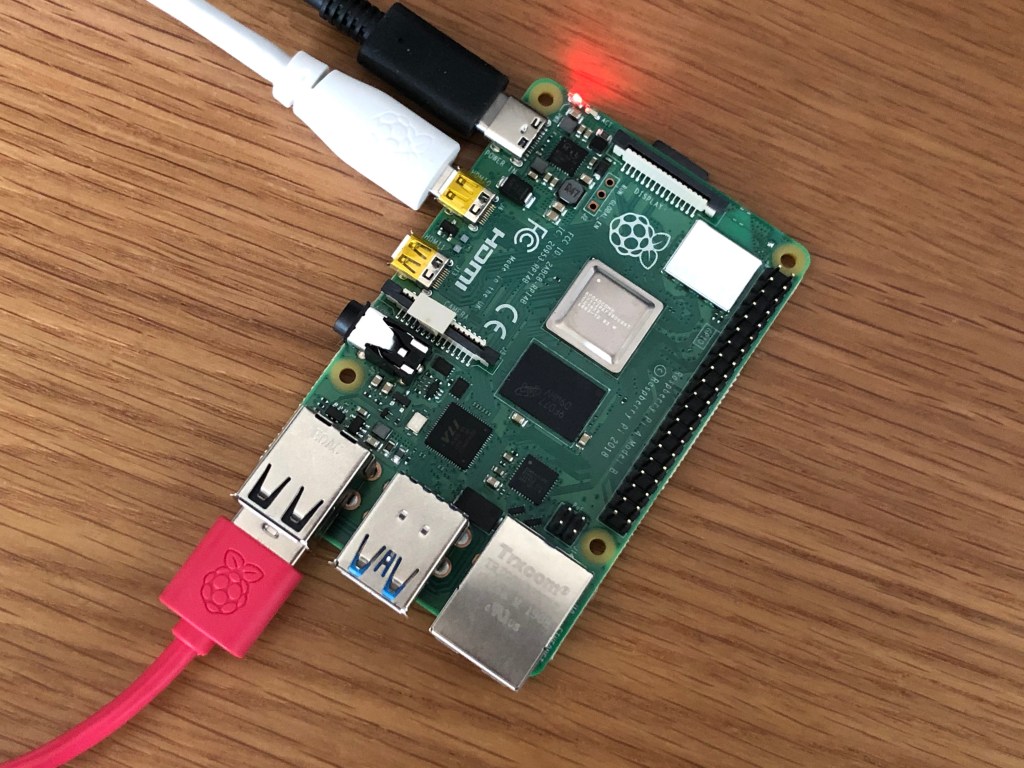
The Raspberry Pi 4 is a great little beast, but Tyler Ward identified a flaw in the USB Type-C connector. The Raspberry Pi Foundation confirmed to TechRepublic that the design flaw is real, and that your Raspberry Pi 4 might not work with all USB-C cables.
It’s not really a dealbreaker, but you can expect a future board revision with a proper implementation of the USB-C protocol. But if you find yourself scratching your head and you don’t understand why your Raspberry Pi is not powering up, now you know why.
The Raspberry Pi Foundation has released the schematics of the board. And there’s a missing CC resistor that let sophisticated chargers negotiate current with the device.
Given that USB-C is a complicated connector, some cables are electronically marked, which means that they have an integrated chip to support a wide range of devices.
For instance, you can use a MacBook Pro charger with plenty of USB-C devices. The charger just figures out how much power it needs to deliver.
But the Raspberry Pi 4 doesn’t support electronically marked cables, such as Apple’s USB-C cables or Google’s Pixel 3 cables. The device is incorrectly identified as an audio adapter accessory.
Fortunately, it doesn’t damage the Raspberry Pi 4 and it doesn’t create any fire hazard. The device just doesn’t power up.
Disrupt 2026: The tech ecosystem, all in one room
Your next round. Your next hire. Your next breakout opportunity. Find it at TechCrunch Disrupt 2026, where 10,000+ founders, investors, and tech leaders gather for three days of 250+ tactical sessions, powerful introductions, and market-defining innovation. Register now to save up to $400.
Save up to $300 or 30% to TechCrunch Founder Summit
1,000+ founders and investors come together at TechCrunch Founder Summit 2026 for a full day focused on growth, execution, and real-world scaling. Learn from founders and investors who have shaped the industry. Connect with peers navigating similar growth stages. Walk away with tactics you can apply immediately
Offer ends March 13.
“I expect this will be fixed in a future board revision, but for now users will need to apply one of the suggested workarounds. It’s surprising this didn’t show up in our (quite extensive) field testing program,” Raspberry Pi Foundation founder Eben Upton told TechRepublic.
A simple workaround is to buy a non e-marked cable or charger. The Raspberry Pi Foundation is selling an $8 USB-C charger for instance. In my testing, it has been working fine for the past couple of weeks.

