

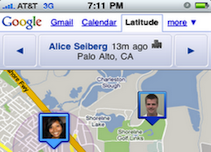
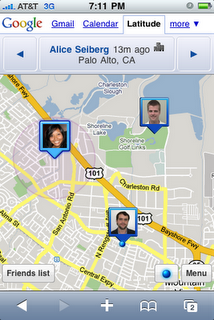
 The ability to multitask got a lot of press when iPhone 4.0 OS was first announced. But less attention was given to some of the more subtle things this will allow, such as always-on location for third-party apps. This feature could actually make a service like Google Latitude useful on the device. So it’s coming, right? Maybe.
I asked Google senior product manager Steve Lee (who is in charge of Latitude) whether Google would build a native app for the iPhone now that it includes background location. “From the start, we’ve made Latitude available across platforms. Supporting iPhone with a great Latitude user experience is extremely important to us, and we’re evaluating the best way to deliver that on iPhone OS 4.0 now, so we don’t have anything to announce just yet,” Lee answer (emphasis his).
Latitude has been available for the iPhone since July of last year — but it is only available as an HTML5 app, not a native app. This makes it pretty useless since you would have to have your web browser open to this page at all times for Latitude to work the web it should — which is all the time. So why didn’t Google release it as a native app? Well, the obvious answer would be that there wasn’t the ability to update location in the background on the iPhone previously, so it didn’t really matter if it was a native app or a web app. But actually it’s more complicated than that.
Back in July, Google actually noted why it was doing Latitude as a web app vs. a native app:
We worked closely with Apple to bring Latitude to the iPhone in a way Apple thought would be best for iPhone users. After we developed a Latitude application for the iPhone, Apple requested we release Latitude as a web application in order to avoid confusion with Maps on the iPhone, which uses Google to serve maps tiles.
At the time, that sounded a little odd to me. After all, there are plenty of other apps that use maps. I wondered if it really meant that Apple was planning on baking this feature into their own Maps app on the iPhone (which was built with the help of Google). But looking back now, it’s likely much more complicated. This was right before it was revealed that Apple rejected the Google Voice app on the grounds that it would confuse iPhone users, or access information on the phone, or something.
The Latitude situation was just the first shot in what is now a full-fledged war between the two companies.
Disrupt 2026: The tech ecosystem, all in one room
Your next round. Your next hire. Your next breakout opportunity. Find it at TechCrunch Disrupt 2026, where 10,000+ founders, investors, and tech leaders gather for three days of 250+ tactical sessions, powerful introductions, and market-defining innovation. Register now to save up to $400.
Save up to $300 or 30% to TechCrunch Founder Summit
1,000+ founders and investors come together at TechCrunch Founder Summit 2026 for a full day focused on growth, execution, and real-world scaling. Learn from founders and investors who have shaped the industry. Connect with peers navigating similar growth stages. Walk away with tactics you can apply immediately
Offer ends March 13.
Long story short, even if Google wants to build a native Latitude app for the iPhone (as they said they did before), Apple may or may not allow it.
Let’s hope they do. Because with the new Location History features, and APIs, it could be awesome. And it could push passive location into the spotlight.

