


Mozilla is adding a new security feature to its Firefox Quantum web browser that will alert users when they visit a website that has recently reported a data breach.
When a Firefox user lands on a website with a breach in its recent past they’ll see a pop up notification informing them of the barebones details of the breach and suggesting they check to see if their information was compromised.
“We’re bringing this functionality to Firefox users in recognition of the growing interest in these types of privacy- and security-centric features,” Mozilla said today. “This new functionality will gradually roll out to Firefox users over the coming weeks.”
Here’s an example of what the site breach notifications look like and the kind of detail they will provide:
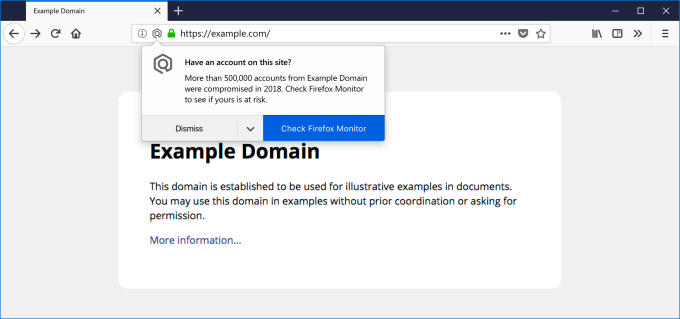
Mozilla is tying the site breach notification feature to an email account breach notification service it launched earlier this year, called Firefox Monitor, which it also said today is now available in an additional 26 languages.
Firefox users can click through to Monitor when they get a pop up about a site breach to check whether their own email was involved.
As with Firefox Monitor, Mozilla is relying on a list of breached websites provided by its partner, Troy Hunt’s pioneering breach notification service, Have I Been Pwned.
Disrupt 2026: The tech ecosystem, all in one room
Your next round. Your next hire. Your next breakout opportunity. Find it at TechCrunch Disrupt 2026, where 10,000+ founders, investors, and tech leaders gather for three days of 250+ tactical sessions, powerful introductions, and market-defining innovation. Register now to save up to $400.
Save up to $300 or 30% to TechCrunch Founder Summit
1,000+ founders and investors come together at TechCrunch Founder Summit 2026 for a full day focused on growth, execution, and real-world scaling. Learn from founders and investors who have shaped the industry. Connect with peers navigating similar growth stages. Walk away with tactics you can apply immediately
Offer ends March 13.
There can of course be a fine line between feeling informed and feeling spammed with too much information when you’re just trying to get on with browsing the web. But Mozilla looks to sensitive to that because it’s limiting breach notifications to one per breached site. It will also only raise a flag if the breach itself occurred in the past 12 months.
Data breaches are an unfortunate staple of digital life, stepping up in recent years in frequency and size along with big data services. That in turn has cranked up awareness of the problem. And in Europe tighter laws were introduced this May to bring in a universal breach disclosure requirement and raise penalties for data protection failures.
The GDPR framework also generally encourages data controllers and processors to improve their security systems given the risk of much heftier fines.
Although it will likely take some time for any increases in security investments triggered by the regulation to filter down and translate into fewer breaches — if indeed the law ends up having that hoped for impact.
But one early win for GDPR is it has greased the pipe for companies to promptly disclose breaches. This means it’s helping to generate more up-to-date security information which consumers can in turn use to inform the digital choices they make. So the regulation looks to be generating positive incentives.

