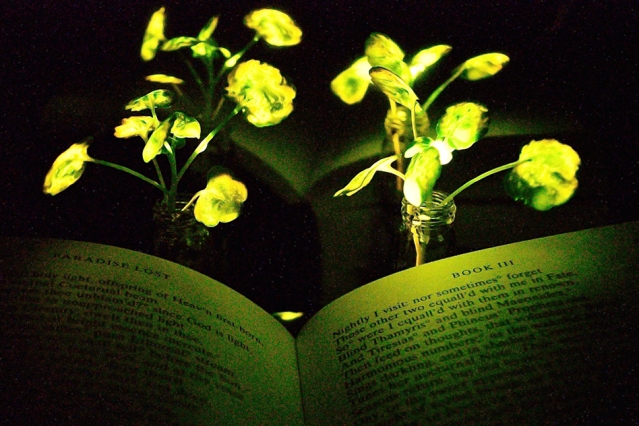
A team of MIT research have engineered plants that glow in the dark, using luciferase, the enzyme that lights up firefly butts. The answer to the question of why, precisely, anyone would want to do such a thing is clearly, “because science is cool.”
The longer and slightly more boring answer, however, has to do with energy savings. Thus far, the scientists have only been able to replicate the results on arugula, kale, spinach and watercress, but their plans for the future are much grander, including trees that could stand in for outdoor electric light.
“The vision is to make a plant that will function as a desk lamp — a lamp that you don’t have to plug in,” says Professor Michael Strano, the study’s senior author. “The light is ultimately powered by the energy metabolism of the plant itself.”
Strano cites a study claiming that lighting is responsible for about 20-percent of energy consumption worldwide. Glow-in-the dark plants could potentially alleviate some of that strain, using their own energy to illuminate a space after nightfall. Of course, that’s all still a ways off. So far, the team has been able to make a plant glow for around three-and-a half hours, but the illumination they give off is apparently one-thousandth of the light required to read by.
So, best to stick with that new Kindle, until the team figures out how to improve things. That will require a better concentration of the enzymes involved, and a way of improving how those enzymes are released.
Disrupt 2026: The tech ecosystem, all in one room
Your next round. Your next hire. Your next breakout opportunity. Find it at TechCrunch Disrupt 2026, where 10,000+ founders, investors, and tech leaders gather for three days of 250+ tactical sessions, powerful introductions, and market-defining innovation. Register now to save up to $400.
Save up to $300 or 30% to TechCrunch Founder Summit
1,000+ founders and investors come together at TechCrunch Founder Summit 2026 for a full day focused on growth, execution, and real-world scaling. Learn from founders and investors who have shaped the industry. Connect with peers navigating similar growth stages. Walk away with tactics you can apply immediately
Offer ends March 13.
According to MIT, this isn’t the first time scientists have attempted to use these enzymes to light up plants, but the process the team is using has improved efficiency quite a bit. The process involves dunking plants in a solution made out of luciferase, luciferin and coenzyme A (a combination of which creates fireflies’ glow) and applying pressure that essentially forces the solution into plant pores.
The researchers are also able to turn the light off by adding a luciferase inhibitor, which doubles as a sort of chemical light switch for when it’s time to turn those glowing plants off.