Sisense introduced a new tool today called Pulse, which uses machine learning to trigger an alert when it detects results outside of normal parameters for a particular metric.
A user can set a Pulse alert to monitor a metric or KPI such as sales activity or win rate. The machine learning component watches the chosen metric and learns over time what’s normal. When it detects an anomaly, it sends an alert to the user. What’s more, it can determine how the metric has changed over time, so it doesn’t continue to trigger alerts for the new normal.
This approach is part of Sisense’s mission to simplify business intelligence, company CEO Amir Orad told TechCrunch. Last year his company introduced an Amazon Echo Skill to allow users to ask Alexa about Sisense data. Pulse gives those users access to data without deliberately going into the tool to seek it out.
“This is a direct continuation of what we’ve been doing — [this notion of] Sisense everywhere where we can push insights into the hands of users. Pulse is another step in that direction. We’ve started with the ability to assign alerts on interesting stuff,” he explained.
In the conventional way of using a tool like Sisense, you fire it up and look at the data. As part of this process, you may see something that’s particularly interesting or crucial to you. You can set a Pulse alert and let the system warn you when a metric is out of whack. Orad says this is flipping the way people have typically used business intelligence tools.
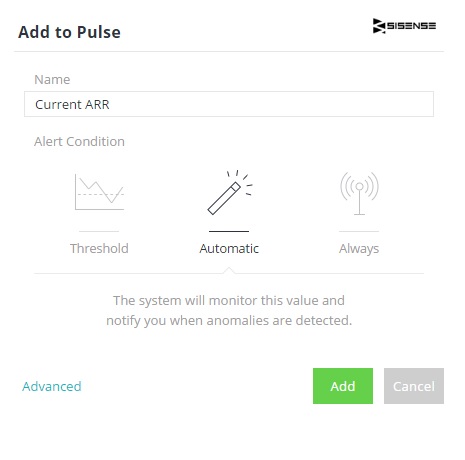
“The value is that, traditionally you are going to your computer and asking a question and getting a report. It’s more interesting when it’s getting pushed to you,” he said. It’s certainly easier, especially when the tool is using machine learning to look at the historical numbers related to this metric.
“You plot a curve over time and see what is typical in the curve. When you get out of that curve, and there is a significant difference, you get an alert,” he said.
Disrupt 2026: The tech ecosystem, all in one room
Your next round. Your next hire. Your next breakout opportunity. Find it at TechCrunch Disrupt 2026, where 10,000+ founders, investors, and tech leaders gather for three days of 250+ tactical sessions, powerful introductions, and market-defining innovation. Register now to save up to $400.
Save up to $300 or 30% to TechCrunch Founder Summit
1,000+ founders and investors come together at TechCrunch Founder Summit 2026 for a full day focused on growth, execution, and real-world scaling. Learn from founders and investors who have shaped the industry. Connect with peers navigating similar growth stages. Walk away with tactics you can apply immediately
Offer ends March 13.
Orad says Pulse doesn’t just have to produce an alert. It could also trigger an action or start a workflow. Sisense has partnered with Zapier, a workflow tool not unlike IFTTT, which enables users to trigger an action or set of actions based on certain conditions. In the Sisense case, it could begin a workflow for new customers or restocking inventory (or any business process).
For now, Sisense is concentrating on the power of the alerts to let users know when something has changed significantly without having to explicitly ask the tool. “We see our mission as simple: simplify complex data so that business users can get value everywhere all the time. The only way to do that is by putting actionable intelligence in their hands,” he said.