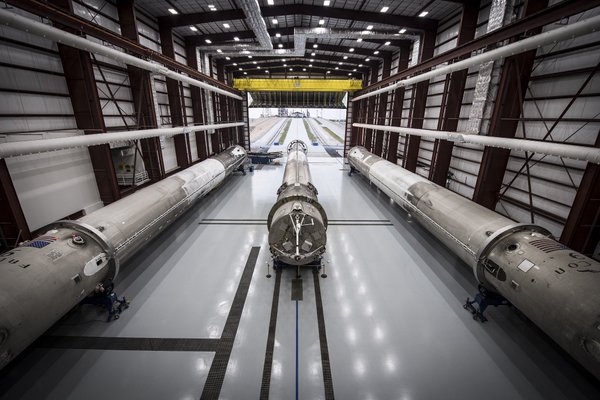
Luxembourg based satellite company SES announced today that they’ve made an agreement with SpaceX to be the first company to launch a payload on a used Falcon 9 rocket.
The re-flight, scheduled to take place late this year, will mark the next big milestone on SpaceX’s path toward rocket reusability. To date, Elon Musk’s rocket company has recovered six Falcon 9 boosters, but hasn’t re-flown any of them.
SpaceX confirmed to TechCrunch that the rocket that will be reflown was the one recovered on a drone ship during the CRS-8 mission to the International Space Station in April. This was SpaceX’s first successful recovery of a rocket on a drone ship.
Since the beginning of the year, SES, the world’s largest commercial operator of geostationary satellites, had expressed their strong desire to be the first company to fly a payload on a SpaceX used rocket.
In fact, SES has a history of placing their trust in SpaceX. They were the first commercial satellite operator to launch with SpaceX in 2013 on a launch that was the company’s first mission to geostationary orbit.
Thanks for the longstanding faith in SpaceX. We very much look forward to doing this milestone flight with you. https://t.co/U2UFez0OhY
— Elon Musk (@elonmusk) August 30, 2016
Disrupt 2026: The tech ecosystem, all in one room
Your next round. Your next hire. Your next breakout opportunity. Find it at TechCrunch Disrupt 2026, where 10,000+ founders, investors, and tech leaders gather for three days of 250+ tactical sessions, powerful introductions, and market-defining innovation. Register now to save up to $400.
Save up to $300 or 30% to TechCrunch Founder Summit
1,000+ founders and investors come together at TechCrunch Founder Summit 2026 for a full day focused on growth, execution, and real-world scaling. Learn from founders and investors who have shaped the industry. Connect with peers navigating similar growth stages. Walk away with tactics you can apply immediately
Offer ends March 13.
More recently, SES had their SES-9 satellite successfully delivered to geostationary orbit with SpaceX in March. On that particular mission, SpaceX attempted to return their first stage to a drone ship, but was unsuccessful.
In a few months, SpaceX’s re-flight mission will take the SES-10 satellite, which will provide telecommunication services to Latin America, to geostationary orbit.
“We believe reusable rockets will open up a new era of spaceflight, and make access to space more efficient in terms of cost and manifest management. This new agreement reached with SpaceX once again illustrates the faith we have in their technical and operational expertise.” Martin Halliwell, Chief Technology Officer at SES
Re-using a rocket is intended to bring launch costs down considerably, which is why companies like SpaceX and Blue Origin are going through the trouble to sort out the difficult technical hurdles.
Back in March, president of SpaceX, Gwynne Shotwell, stated that their company expected a 30 percent cost savings by reusing the Falcon 9 first stage.
“Re-launching a rocket that has already delivered spacecraft to orbit is an important milestone on the path to complete and rapid reusability. SES has been a strong supporter of SpaceX’s approach to reusability over the years and we’re delighted that the first launch of a flight-proven rocket will carry SES-10.” Gwynne Shotwell, President and Chief Operating Officer of SpaceX
When asked if this launch will, in fact, cost less, SES told TechCrunch, “We cannot disclose the amount, but what we can say is that by relying upon a Falcon 9 with a using a SpaceX’s reusable rocket booster, we are talking about a discount in launch cost as well as an increase in launch frequency due to the increased availability of qualified, pre-flown vehicles. Both aspects are important since access to space and timely availability of launch vehicles are key for us.”
In addition to this re-flight, SpaceX has a few other exciting milestones planned for this year. Musk’s company intends to triple their launch frequency compared to 2015 and complete the maiden launch of their Falcon Heavy rocket. If all of this can be done in the remaining four months, 2016 is set to be one of the biggest, most ambitious years for SpaceX.