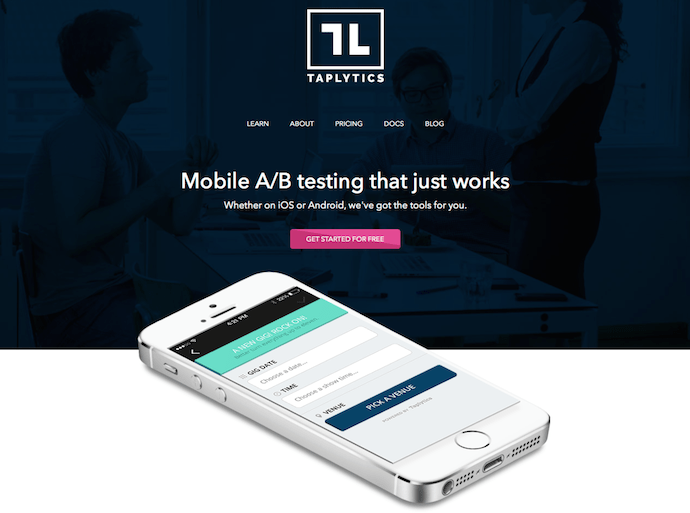
Taplytics, a Y Combinator-backed A/B testing service for mobile apps, is announcing two big additions today — support for Android apps and an analytics product called Taplytics Insights.
Service like Taplytics allow developers to test variations of their app interface and code, and to make those changes without going through the App Store approval and update process. (There are a number of other startups focused on mobile testing, including Apptimize — and Optimizely, the big player in desktop testing, announced iOS support earlier this year.)
Taplytics already “soft launched” its new features, making them available to some developers but not officially announcing them. The Android bit is easier to explain — the service was previously iOS-only, but now it supports Android apps, too. Co-founder and CEO Aaron Glazer told me that adding Android was always in the company’s plans (“It was a no brainer”), and that it could be useful to both Android-focused developers and cross-platform app-makers who “really have to understand how user behavior changes between your iOS and your Android products.”
Glazer also said that Taplytics already offered some basic experiment data to its customers — after all, if you’re testing different variations, you need to see which ones are actually performing best. With Taplytics Insights, on the other hand, developers can get more detailed information about its users and what they’re doing in the app. (To a certain extent, the Taplytics approach is starting to converge with Mixpanel, an analytics company that recently added A/B testing.)

Glazer said Taplytics Insights are available to all customers for now additional charge. Here’s how he described the product in a follow-up email:
The key goal with insights is to give our customers as much actionable data as possible to get as close as we can to determining cause and effect. So we give customers key indicators like acquisition, engagement, cohort and retention analysis and activation analysis without any instrumentation.
Techcrunch eventDisrupt 2026: The tech ecosystem, all in one room
Your next round. Your next hire. Your next breakout opportunity. Find it at TechCrunch Disrupt 2026, where 10,000+ founders, investors, and tech leaders gather for three days of 250+ tactical sessions, powerful introductions, and market-defining innovation. Register now to save up to $400.
Save up to $300 or 30% to TechCrunch Founder Summit
1,000+ founders and investors come together at TechCrunch Founder Summit 2026 for a full day focused on growth, execution, and real-world scaling. Learn from founders and investors who have shaped the industry. Connect with peers navigating similar growth stages. Walk away with tactics you can apply immediately
Offer ends March 13.San Francisco, CA | October 13-15, 2026We also give them deep dive insight into exactly what each user or each cohort of users is doing in their app, right down to time spent on each view and actions taken. This data is all organizable by device type, geography, experiment and variation allocation, as well as any customer defined custom variables.
He added that the combined analytics and testing product allows developers to pursue a strategy of “continuous iteration,” where they’re constantly looking at the data to find areas where they could be doing better, then testing out different ways to improve the app.
And Glazer suggested that developers have started to use Taplytics as “an insurance policy” for your their apps, because it allows them to immediately hide or turn off features that may be causing problems. For example, he said one customer had an iOS 8 bug that broke the checkout process in their app, but they were able to able to select a variation that essentially removed whatever was causing the crash.
Taplytics customers include Frank & Oak, WordPress, and Homejoy.