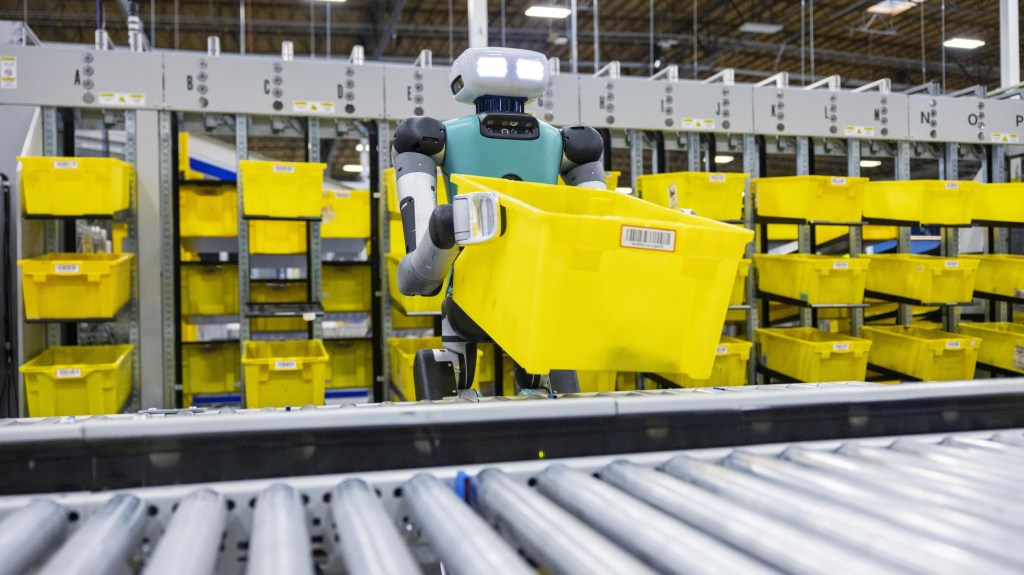
After a year-long pilot project, Toyota’s Canadian manufacturing subsidiary has contracted seven humanoid robots to work in a plant building RAV4 SUVs under a robots-as-a-service deal.
“After evaluating a number of robots, we are excited to deploy Digit to improve the team member experience and further increase operational efficiency in our manufacturing facilities,” Toyota Motor Manufacturing Canada (TMMC) President Tim Hollander said in a statement.
The Digit robot in question is built by Agility Robotics, a firm spun out of Oregon State University in 2015. Digit is intended to work in industrial environments without humans nearby, often bridging two automated production lines. In this case, the robots will be unloading totes full of auto parts from an automated warehouse tugger.
While seven robots doing manual drudgery may seem a small step compared to sizzle reels of metal humans doing backflips, actually deploying humanoid robots in real workplaces is rare and difficult. Demonstrating a capability in a lab is one thing, but integrating it into a company’s workflow — including maintenance and charging — isn’t easy.
“When the tech companies spend real time in the field understanding the task that needs to be operated, the real workflows that happens…that’s when we will see a huge uptick in adoption,” Ram Devarajulu, a VP at Cambridge Consultants, said at the Humanoids Summit in late 2025.
Agility is among the leaders in getting robots out of the lab, with Digits working in similar capacities for logistics providers like GXO, Schaeffler, and Amazon. The company has a proprietary cloud-based software package called Arc for users to manage fleets of their robots, and says AI will be vital in reducing deployment costs.
“Cost of deployment … can be more than the price of the robot by a lot,” Pras Velagapudi, Agility’s CTO, said in an interview last year. “AI tools let us decrease that cost of deployment, decrease the amount of time getting the robot configured and getting it operating at a level of performance that they want.”
Disrupt 2026: The tech ecosystem, all in one room
Your next round. Your next hire. Your next breakout opportunity. Find it at TechCrunch Disrupt 2026, where 10,000+ founders, investors, and tech leaders gather for three days of 250+ tactical sessions, powerful introductions, and market-defining innovation. Register now to save up to $400.
Save up to $300 or 30% to TechCrunch Founder Summit
1,000+ founders and investors come together at TechCrunch Founder Summit 2026 for a full day focused on growth, execution, and real-world scaling. Learn from founders and investors who have shaped the industry. Connect with peers navigating similar growth stages. Walk away with tactics you can apply immediately
Offer ends March 13.
TMMC and Agility will use this engagement as an opportunity to pioneer other use cases that relieve human workers of repetitive physical tasks and prioritize more valuable work.
The company is also preparing a next-generation robot that will be safe to operate alongside human workers; current humanoid robots that are strong enough to lift heavy loads are still considered too unreliable to operate autonomously around people.
Competitor Figure AI tested its Figure 02 robots in a BMW factory for 10 months last year, which the company said unloaded 90,000 parts. Other companies deploying humanoids in pilot programs include Apptronic, Unitree, Tesla, Boston Dynamics, 1X Technology, and Reflex Robotics.