
Back in 2019, Microsoft open sourced Dapr, a new runtime for making building distributed microservice-based applications easier. At the time, nobody was talking about AI agents yet, but as it turns out, Dapr had some of the fundamental building blocks for supporting AI agents built-in from the outset. That’s because one of Dapr’s core features is a concept of virtual actors, which can receive and process messages independently from all the other actors in the system.
Today, the Dapr team is launching Dapr Agents, its take on helping developers build AI agents by providing them with a lot of the building blocks to do so.
“Agents are a very good use case for Dapr,” Dapr co-creator and maintainer Yaron Schneider explained. “From a technical perspective, you could use actors as a very lightweight way to run these agents and really be able to run them at scale with state — and be resource-efficient. This is all great, but then, there is still a lot of business logic you need to write. The statefulness and the orchestration of it are just one part. And many people, they might choose a workflow engine or an actor framework, but there’s still a lot of work they need to do to actually write the agent logic on the other side. There is lots of agent frameworks out there, but they don’t have the same level of orchestration and statefulness that Dapr has.”
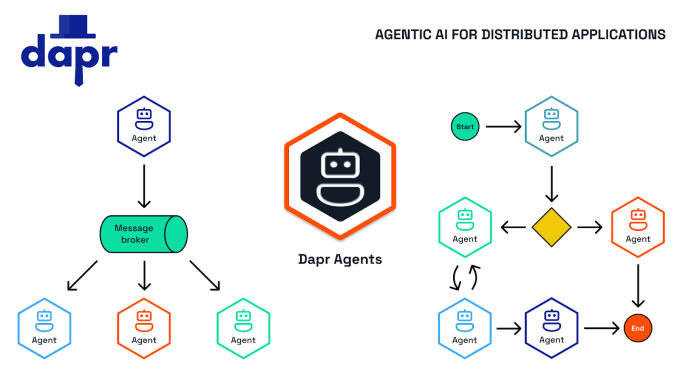
Dapr Agents originated from Floki, a popular open source project that extended Dapr for this AI agent use case. Talking with the project maintainers, including Microsoft AI researcher Roberto Rodriguez, the two teams decided to bring the project under the Dapr umbrella to ensure the continuity of the new agent framework.
“In many ways we see agentic systems and the whole terminology around that as another term for ‘distributed systems,’ Dapr co-creator and maintainer Mark Fussell said. “[…] Rather than calling them microservices, you can call them agents now, mostly because you can put large language models amongst them all.”
To efficiently coordinate those agents, you do need an orchestration engine and statefulness, the team argues — which is exactly what Dapr delivers. That’s in part because Dapr’s actors are meant to be extremely efficient and able to spin up within milliseconds when a message comes in (and shut down, with their state preserved, when their job is done).
Right now, Dapr Agents can talk to most of the popular model providers out of the box. These include AWS Bedrock, OpenAI, Anthropic, Mistral, and Hugging Face. Support for local LLMs will arrive very soon.
Disrupt 2026: The tech ecosystem, all in one room
Your next round. Your next hire. Your next breakout opportunity. Find it at TechCrunch Disrupt 2026, where 10,000+ founders, investors, and tech leaders gather for three days of 250+ tactical sessions, powerful introductions, and market-defining innovation. Register now to save up to $400.
Save up to $300 or 30% to TechCrunch Founder Summit
1,000+ founders and investors come together at TechCrunch Founder Summit 2026 for a full day focused on growth, execution, and real-world scaling. Learn from founders and investors who have shaped the industry. Connect with peers navigating similar growth stages. Walk away with tactics you can apply immediately
Offer ends March 13.
On top of interacting with these models, since Dapr Agents extend the existing Dapr framework, developers also get the ability to define a list of tools that the agent can then use to fulfill a given task.
Currently, Dapr Agents supports Python, with .NET support launching soon. Java, JavaScript and Go will follow soon.