
OpenAI may have designs to get into the search game — challenging not only upstarts like Perplexity, but Google and Bing, too.
The company on Thursday unveiled SearchGPT, a search feature designed to give “timely answers” to questions, drawing from web sources.
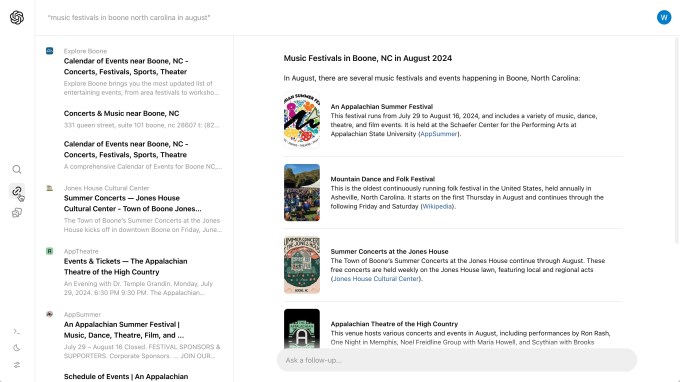
UI-wise, SearchGPT isn’t too far off from OpenAI’s chatbot platform ChatGPT. You type in a query, and SearchGPT serves up information and photos from the web along with links to relevant sources, at which point you can ask follow-up questions or explore additional, related searches in a sidebar.
Some searches take into account your location. In a support doc, OpenAI writes that SearchGPT “collects and shares” general location information with third-party search providers to improve the accuracy of results (e.g. showing a list of restaurants nearby or the weather forecast). SearchGPT also allows users to share more precise location information via a toggle in the settings menu.
Powered by OpenAI models (specifically GPT-3.5, GPT-4 and GPT-4o), SearchGPT — which OpenAI describes as a prototype — is launching today for “a small group” of users and publishers. (There’s a waitlist here.) OpenAI says that it plans to integrate some features of SearchGPT into ChatGPT in the future.
“Getting answers on the web can take a lot of effort, often requiring multiple attempts to get relevant results,” OpenAI writes in a blog post. “We believe that by enhancing the conversational capabilities of our models with real-time information from the web, finding what you’re looking for can be faster and easier.”
It’s long been rumored that OpenAI’s taken an interest in launching a Google killer of sorts. The Information reported in February that a product — or at least a pilot — was in the works. But the launch of SearchGPT comes at an inopportune moment: as AI-powered search tools are under justifiable fire for plagiarism, inaccuracies and content cannibalism.
Disrupt 2026: The tech ecosystem, all in one room
Your next round. Your next hire. Your next breakout opportunity. Find it at TechCrunch Disrupt 2026, where 10,000+ founders, investors, and tech leaders gather for three days of 250+ tactical sessions, powerful introductions, and market-defining innovation. Register now to save up to $400.
Save up to $300 or 30% to TechCrunch Founder Summit
1,000+ founders and investors come together at TechCrunch Founder Summit 2026 for a full day focused on growth, execution, and real-world scaling. Learn from founders and investors who have shaped the industry. Connect with peers navigating similar growth stages. Walk away with tactics you can apply immediately
Offer ends March 13.
Google’s take on AI-powered search, AI Overviews, infamously suggested putting glue on a pizza. The Browser Company’s Arc Search told one reporter that cut-off toes will grow back. AI search engine Genspark at one time readily recommended weapons that could be used to kill someone. And Perplexity ripped off news articles written by other outlets, including CNBC, Bloomberg, and Forbes, without giving credit or attribution.
AI-generated overviews threaten to cannibalize traffic to the sites from which they source their info. Indeed, they already are, with one study finding that AI Overviews could negatively affect about 25% of publisher traffic due to the de-emphasis on article links.
OpenAI — taking a page out of Perplexity’s ongoing apology tour — is positioning SearchGPT as a more responsible, measured deployment.
OpenAI says that SearchGPT “prominently cites and links” to publishers in searches with “clear, in-line, named attribution.” It also says that it’s working with publishers to design the experience and providing a way for website owners to manage how their content appears in search results.
“Importantly, SearchGPT is about search and is separate from training OpenAI’s generative AI foundation models. Sites can be surfaced in search results even if they opt out of generative AI training,” OpenAI clarifies in the blog post. “We are committed to a thriving ecosystem of publishers and creators.”
It’s a bit tough to take a company that once scraped millions of YouTube transcripts without permission to train its models at their word. But we’ll see how the SearchGPT saga unfolds.