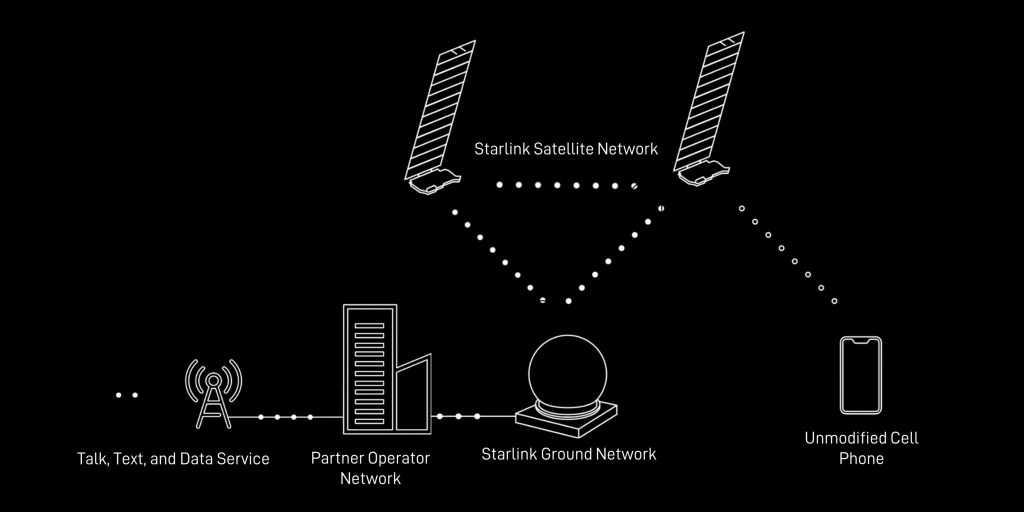
SpaceX launched its first batch of Starlink satellites that will be able to connect directly to cell phones ahead of planned testing later this year.
The company launched six Starlink satellites with this capability with a batch of 15 other Starlink birds aboard a Falcon 9 rocket late last night. SpaceX obtained approval from U.S. regulators last month to test the satellites in partnership with T-Mobile. SpaceX has a number of other partnerships with native telecom companies in countries including Australia, Canada and Japan.
The approval, which was granted by the U.S. Federal Communications Commission, was for a 180-day period. SpaceX said the tests would eventually involve 840 satellites transmitting 4G connectivity to around 2,000 unmodified smartphones. The satellites will act as “cell phone towers in space,” according to Starlink’s website.
The website estimates that texting will become available this year, with voice and data services starting in 2025 and connection for Internet of Things devices also in 2025, though SpaceX will need to get regulatory approval before commencing commercial service.
While SpaceX CEO Elon Musk said that the service “will allow for mobile phone connectivity anywhere on Earth,” he added some realistic caveats: “While this is a great solution for locations with no cellular connectivity, it is not meaningfully competitive with existing terrestrial cellular networks.”
This will allow for mobile phone connectivity anywhere on Earth.
Note, this only supports ~7Mb per beam and the beams are very big, so while this is a great solution for locations with no cellular connectivity, it is not meaningfully competitive with existing terrestrial… https://t.co/ymHpw8XBHl
Techcrunch eventDisrupt 2026: The tech ecosystem, all in one room
Your next round. Your next hire. Your next breakout opportunity. Find it at TechCrunch Disrupt 2026, where 10,000+ founders, investors, and tech leaders gather for three days of 250+ tactical sessions, powerful introductions, and market-defining innovation. Register now to save up to $400.
Save up to $300 or 30% to TechCrunch Founder Summit
1,000+ founders and investors come together at TechCrunch Founder Summit 2026 for a full day focused on growth, execution, and real-world scaling. Learn from founders and investors who have shaped the industry. Connect with peers navigating similar growth stages. Walk away with tactics you can apply immediately
Offer ends March 13.San Francisco, CA | October 13-15, 2026— Elon Musk (@elonmusk) January 3, 2024
But even with these limitations, there is undoubtably a race among companies looking to take a share of the direct-to-cell market. Other players include Lynk, which has debuted services in Palau, Amazon’s Project Kuiper and AST SpaceMobile. Kuiper — which is a more general competitor to SpaceX’s Starlink constellation — announced its own partnership with Verizon in 2021, while AST’s telco partners include AT&T and Vodafone.