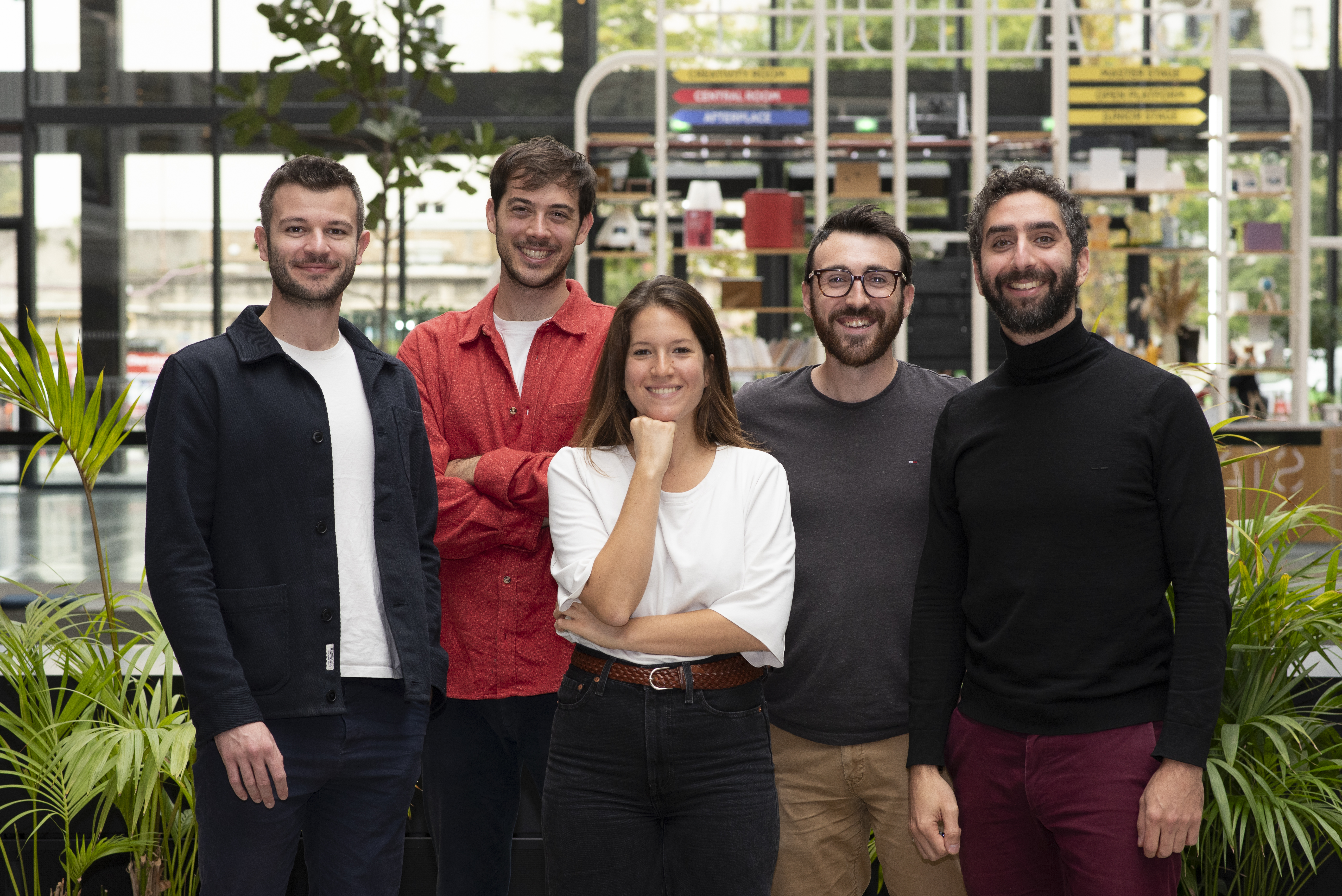
Pimento is a new French startup that is using generative AI in an interesting way, as the company focuses on the first step of creative processes — ideation, brainstorming and moodboarding. And the company recently raised a $3.2 million (€3 million) funding round from an interesting list of investors.
The best way to describe Pimento is by talking about people who could use a tool like this. Creative teams working on a brand redesign, an ad campaign, an upcoming video game or an animation movie will open Pimento on the first day of their new projects. It’s the tool that you use to start the research process.
These users want to compile a reference document with images, text and colors that will be used down the road for these projects. They will serve as the main inspiration and the first guidelines of the project for other teams working on it.
And there’s a lot of back and forth during this phase because clients or managers can be picky and often change their mind. They give you a direction for the next meeting in two weeks, but then they don’t like what the creative team brings to the table so creative workers have to start from scratch again.
Right now, many creative workers rely on Pinterest, Instagram, Behance, Canva and Figma to find images around the web and create mood boards. And in many ways, your creativity is defined by the tools that you use. The Pimento team hopes that it can foster your creativity thanks to artificial intelligence.
“It allows you to explore more directions more quickly, so that you can produce projects of higher quality,” co-founder Tomás Yany told me. AI models “bring a wealth of knowledge that no designer will ever have. They’ve seen a lot of things, because they were originally trained with data from Japan and Latin America,” he added later in the conversation as an example.
Pimento’s seed round was led by Partech and Cygni Capital. Several angel investors also participated in the round, such as Julien Chaumond (Hugging Face), Stanislas Polu (Dust), Thibaud Elzière (Hexa), Jean-Charles Samuelian (Alan), Igor Manceau (former creative director at Ubisoft), Jonathan Widawski (Maze), Alessandro Sabatelli (ex-Apple) and Nicolas Steegmann (ex-Stupeflix).
Disrupt 2026: The tech ecosystem, all in one room
Your next round. Your next hire. Your next breakout opportunity. Find it at TechCrunch Disrupt 2026, where 10,000+ founders, investors, and tech leaders gather for three days of 250+ tactical sessions, powerful introductions, and market-defining innovation. Register now to save up to $400.
Save up to $300 or 30% to TechCrunch Founder Summit
1,000+ founders and investors come together at TechCrunch Founder Summit 2026 for a full day focused on growth, execution, and real-world scaling. Learn from founders and investors who have shaped the industry. Connect with peers navigating similar growth stages. Walk away with tactics you can apply immediately
Offer ends March 13.
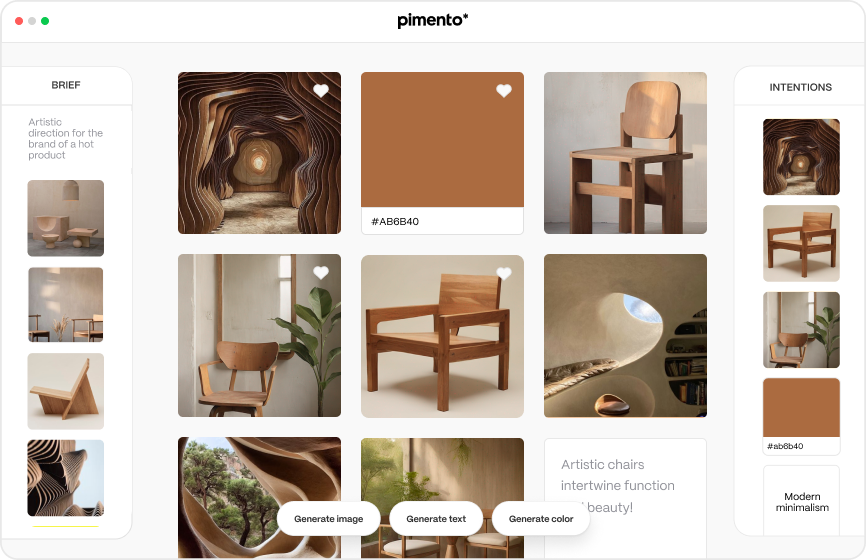
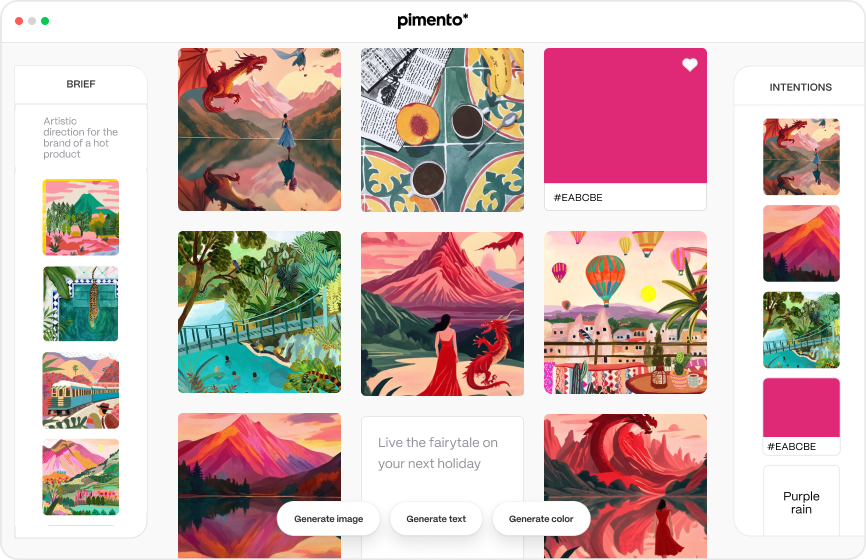
So how do you use the tool exactly? Pimento’s co-founders showed me a demo of the product. You start by typing some instructions of what you’re looking to achieve with your project, a sort of text brief. You then add a handful of images that will serve as the basis of your project.
After that, Pimento uses your instructions with AI models to help you come up with images, text and colors. There are three buttons on the screen that you can use whenever you want to generate images, text or colors.
If some of Pimento’s propositions seem interesting, you can save them for later. When you’re done, you can generate a link and share a board with all the images, colors and text that you have saved.
What makes Pimento different from using an off-the-shelf image-generating AI model is that everything you generate in Pimento is tailored to your initial brief — it becomes a sort of creative companion. In addition to that, you can also iterate on Pimento’s output.
For instance, you can select two images that you like and merge them to iterate one step further. You can pick a color from an image. You can reuse text to generate more images. You can ask for more image variants.
“There’s a debate on how you interact with these AI models. I don’t think the future is a chat interface where you enter a prompt,” co-founder Florent Facq told me. It doesn’t mean that there’s no prompting in Pimento. But the company plans to offer several ways to interact with your content.
In the future, the company plans to add more features, such as the ability to customize the board that you’re going to share with the team or the client. Right now, the company uses fine-tuned open source models, such as Stable Diffusion, Llama and soon Mistral AI.
It’s clear that there’s a long roadmap of new features that could be interesting for a product like Pimento. And the recent funding round will definitely help when it comes to product development. It’s also going to be interesting to see how companies start using the product.