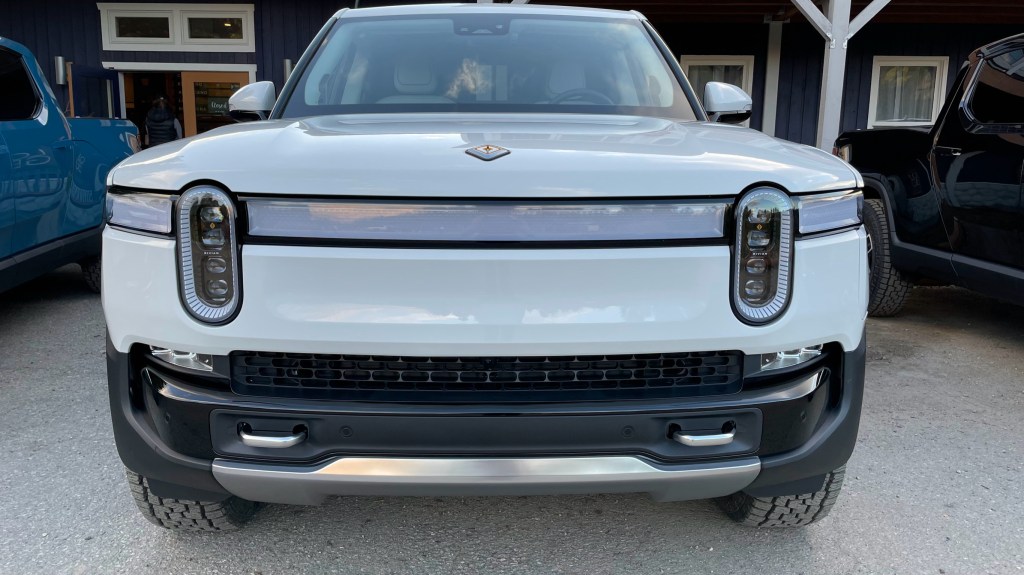
Rivian has hired former Waymo executive James Philbin to lead autonomy and AI at the automaker, a new role that signals the company’s interest in automated driving technology.
Philbin was director of software engineering for two years at Waymo. Before that, Philbin worked for five years at Amazon’s self-driving subsidiary Zoox, where he lead computer vision and perception.
“As we look at our future roadmap and the integral role of AI/ML, James’ arrival couldn’t come at a more impactful time,” Rivian founder and CEO RJ Scaringe wrote in a LinkedIn post.
Scaringe reiterated that point Wednesday while onstage at TechCrunch Disrupt. Scaringe said he expects Level 2 and Level 3 systems that handle many driving tasks while still requiring a human driver to take over if necessary will get better over time and scale faster than the more hardware-heavy Level 4 systems that are designed to handle all of the driving in certain conditions.
“I think what we’ve seen happen with the hardware-heavy systems are that it takes a lot of capital and the roadmap is much longer than most anticipated,” said Scaringe.
Companies like Aurora, Argo AI, Cruise, Waymo and Zoox have spent billions developing autonomous vehicles for ride-hail and delivery, but have yet to commercialize at scale.
Meanwhile, “hardware-constrained” vehicles, or vehicles with fewer sensors and lower levels of autonomy, are present on hundreds of thousands of consumer and commercial vehicles today.
Disrupt 2026: The tech ecosystem, all in one room
Your next round. Your next hire. Your next breakout opportunity. Find it at TechCrunch Disrupt 2026, where 10,000+ founders, investors, and tech leaders gather for three days of 250+ tactical sessions, powerful introductions, and market-defining innovation. Register now to save up to $400.
Save up to $300 or 30% to TechCrunch Founder Summit
1,000+ founders and investors come together at TechCrunch Founder Summit 2026 for a full day focused on growth, execution, and real-world scaling. Learn from founders and investors who have shaped the industry. Connect with peers navigating similar growth stages. Walk away with tactics you can apply immediately
Offer ends March 13.
“So there’s this wonderful learning that you get from the deployed fleet. And so while there’s less hardware, the role that AI and ML (machine learning) can play in your camera’s training, therefore, your planning algorithms, is really quite powerful,” said Scaringe. “And so our view as a company is really a more hardware-constrained system that can be applied across a lot of vehicles in millions and millions of miles is a platform that’s going to have the better long term potential.”
Over time, Scaringe said Rivian will add new sensing modalities to its vehicles. As chipmakers increase compute capacity, the automaker could expand to Level 4 autonomy, he added.
Improving Rivian’s autonomous functions isn’t just a move to attract customers looking for the next replacement to Tesla’s Autopilot. Scaringe said Rivian’s insurance products actually incentivize using Driver+, Rivian’s brand of advanced driver assist system.
“The reason for that is it’s much better than the best human,” said Scaringe. “The vehicle’s not going to check its phone for a text, it’s not going to get distracted by something out the window. So the safety aspect of moving into these Level 2, Level 3 systems that intentionally drive towards more and more time being driven by the vehicle itself is meaningful and real.”