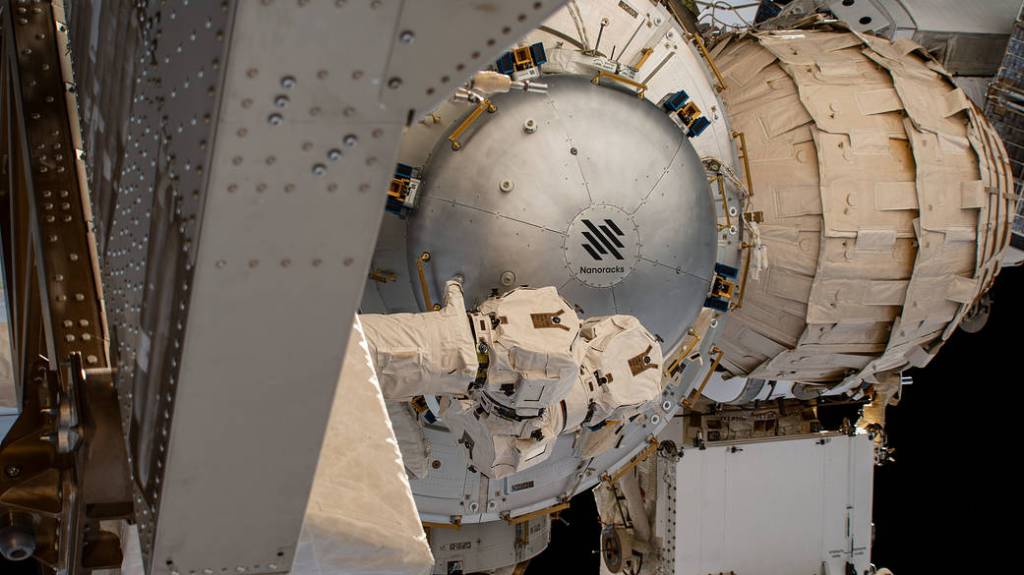
Nanoracks and Tokyo-based space startup Gitai are teaming up for a second technology demonstration on the International Space Station, a mission that could bring the Japanese startup one step closer to commercializing its autonomous in-space robotics.
The two companies will be testing Gitai’s autonomous robotic system, dubbed “S2,” which will operate outside Nanoracks’ Bishop Airlock, the first fully private airlock to be attached to the ISS. Gitai completed its first demonstration of the autonomous robotic arm “S1” last year in the airlock, where the robot executed two common crew tasks: assembling structures and panels and operating cables and switches.
This new robotic system is more complex than its predecessor, with two robotic arms instead of one. It will demonstrate in-space servicing, assembly, and manufacturing (ISAM) activities — a whole range of tasks (like fastening task panels and mating electrical connectors) that are vital to operating safely in space. This time around, the robot will be outside the Airlock, so the mission has the added bonus of demonstrating extravehicular capability and the robots’ capacity to operate in the cold vacuum of space.
Check out a video of a ground demonstration of S2 here:
Extravehicular activities, or “spacewalks,” are some of the most dangerous for astronauts — especially when one considers radiation, against which an astronaut has only a spacesuit for protection — but humans have had to notch hundreds of hours just to maintain the aging ISS. In April, NASA announced that there had been over 250 spacewalks at the station.
For this reason alone, developing capable robots that can replace humans in everyday ISAM activities will likely be crucial to expanding humanity’s presence in space. Nanoracks, along with parent company Voyager Space and Lockheed Martin, have plans to launch a fully private space station called “Starlab” by the end of the decade. It is one of several proposals for commercial stations to replace the ISS once it is decommissioned, and it’s a sign that there will likely be more humans in space at any given moment than ever before in history.
Disrupt 2026: The tech ecosystem, all in one room
Your next round. Your next hire. Your next breakout opportunity. Find it at TechCrunch Disrupt 2026, where 10,000+ founders, investors, and tech leaders gather for three days of 250+ tactical sessions, powerful introductions, and market-defining innovation. Register now to save up to $400.
Save up to $300 or 30% to TechCrunch Founder Summit
1,000+ founders and investors come together at TechCrunch Founder Summit 2026 for a full day focused on growth, execution, and real-world scaling. Learn from founders and investors who have shaped the industry. Connect with peers navigating similar growth stages. Walk away with tactics you can apply immediately
Offer ends March 13.
“There are a tremendous number of applications in space that our robotic arm can be used for, including on-orbit servicing and lunar exploration, and we are thrilled to be able to partner with Nanoracks yet again,” Sho Nakanose, founder and CEO of Gitai, said in a statementI. “Our vision is to provide an affordable and safe means of labor in space, and this opportunity on the Bishop Airlock brings us one step closer to making that happen.”