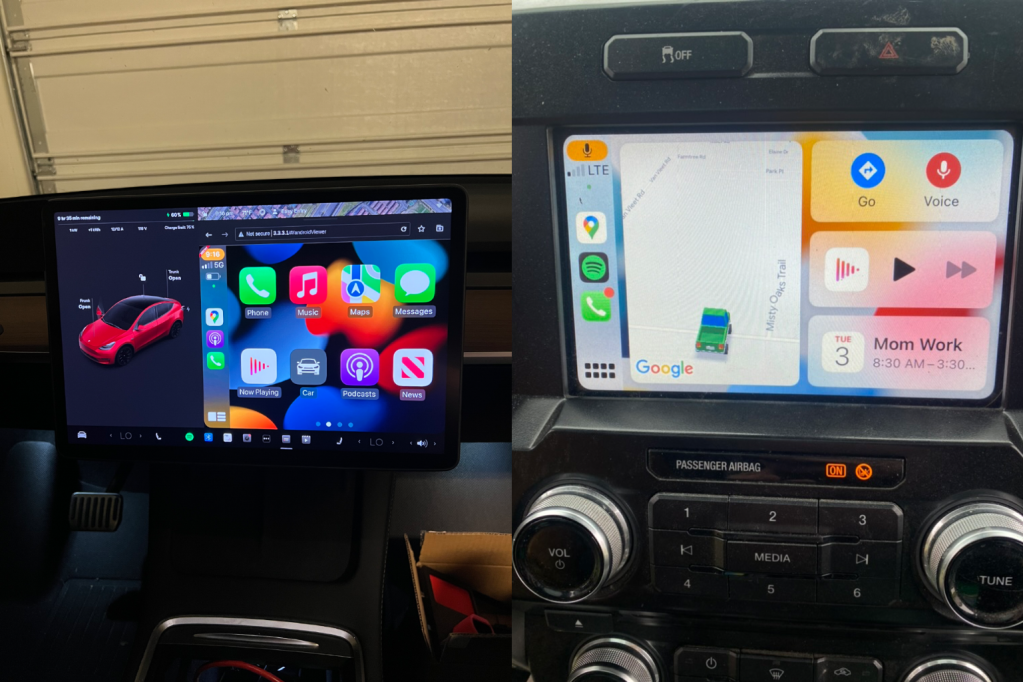
Want to make your old vehicle feel newer? Add a new stereo. Twenty years ago, that would involve ripping out the stock radio and sliding in a new Pioneer head unit and maybe a pair of subwoofers. This time around, it means hacking a new UI onto the stock operating system.
Last week, I added CarPlay to my 2016 Ford F-150. This hack required one piece of hardware and about three minutes. All I had to do was swap the 2016 USB port with a 2017 USB port. CarPlay was immediately available in the Sync 3 system thanks to a 2017 update. Have a Tesla? It’s a bit more work.
Essentially the hack involves tricking the Tesla into thinking it’s running an Android tablet, allowing it to host Apple CarPlay or Android Auto. To do so requires two Raspberry Pis and some software. Detailed instructions are available here on the Tesla Android Project site.
CarPlay on Tesla! It’s here! Spent the afternoon tinkering with @TeslaAndroid and it’s the real deal!
It’s using a few raspberry pies and software wizardry to send wireless android to the Tesla, giving you full CarPlay or Android Auto. pic.twitter.com/nW4Lbtddtv
— Robert Rosenfeld (@robertrosenfeld) May 8, 2022
Disrupt 2026: The tech ecosystem, all in one room
Your next round. Your next hire. Your next breakout opportunity. Find it at TechCrunch Disrupt 2026, where 10,000+ founders, investors, and tech leaders gather for three days of 250+ tactical sessions, powerful introductions, and market-defining innovation. Register now to save up to $400.
Save up to $300 or 30% to TechCrunch Founder Summit
1,000+ founders and investors come together at TechCrunch Founder Summit 2026 for a full day focused on growth, execution, and real-world scaling. Learn from founders and investors who have shaped the industry. Connect with peers navigating similar growth stages. Walk away with tactics you can apply immediately
Offer ends March 13.
CarPlay and Android Auto say the quiet part: in-car infotainment systems still suck. Some are better than others, but most are still lacking in user interactions. CarPlay and Android Auto are better, but still not perfect. However, they do an excellent job of giving the driver safe access to relevant information on their devices for the most part.
There are a handful of aftermarket devices that support CarPlay. The best route is often an OEM upgrade that adds functionality within the standard in-vehicle system. Sometimes, like with my F-150, this is a trivial upgrade, but other times, it’s expensive, requiring a dealership to swap costly control systems. Different solutions come from third parties like Sony or Pioneer and need owners to swap out the stock radio with a new one. If that’s not an option, a handful of dash-mounted screens offer CarPlay as a supplemental service — these are cute, but offer a sub-standard experience in my experience.
Tesla has been a key holdout against CarPlay. It’s logical, in a way, as Tesla vehicles use one screen to control everything in the car, and there’s likely hesitation toward allowing another user interface on the only screen. But other manufacturers have made it work. Volvo, like Tesla, has giant screens in place of dedicated buttons for the radio and climate controls. Drivers can still use CarPlay and access vehicle control systems. The same thing in RAM trucks — there’s a massive, center-mounted screen that controls everything in the truck, but CarPlay still works. Until (or if) Tesla officially supports CarPlay, there’s always the hack linked here.