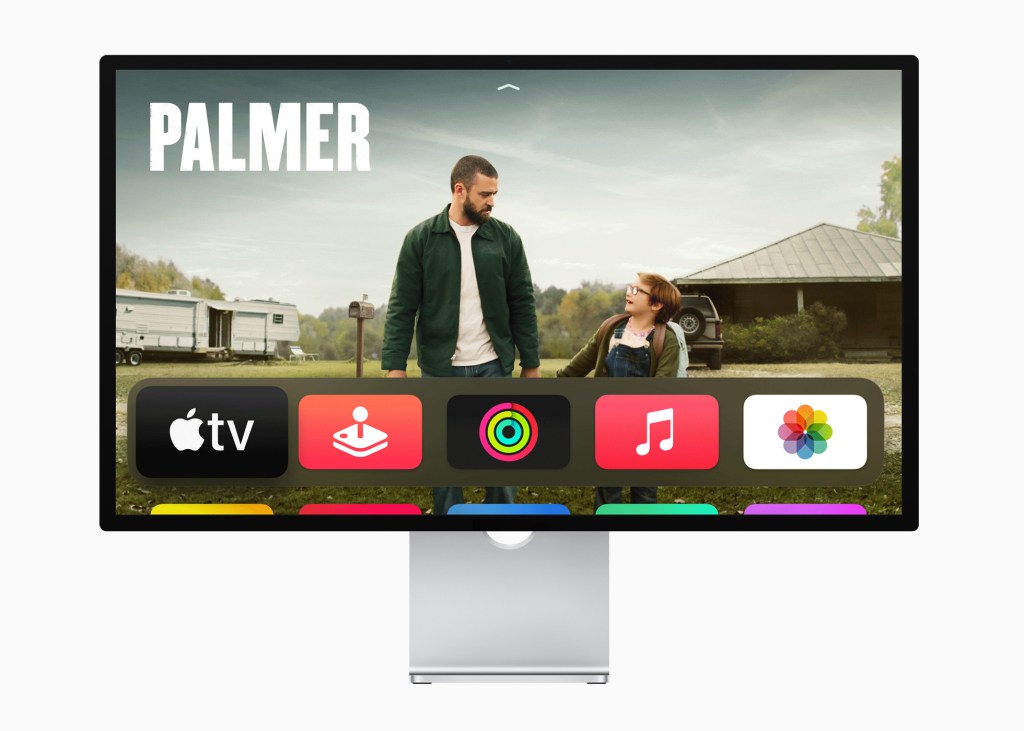
Apple finally delivered what many have been asking for in the Apple enthusiast community: a first-party display that doesn’t cost a minimum of $5,000. The new 27-inch Studio Display instead costs $1,600, which is still a lot more than a lot of people want to pay for a monitor, but it’s still probably a welcome addition for many. Apple even put a whole-ass A13 chip inside, which is more powerful than the chip that currently powers the 4K Apple TV.
Which begs the question: Why isn’t the Studio Display also an Apple TV?
It’s already got the chip — it might be missing the onboard storage but adding that would be a pretty insignificant task in the quantities required to run tvOS and a few media apps. There are also examples of other companies already doing this: Samsung M-series Smart Monitor’s have a smart TV mode with their awful homespun software onboard.
I floated this idea in the TechCrunch Slack and got back some tepid takes about why it doesn’t make sense — you’re hooking the Studio Display up to a Mac that can ostensibly replicate all the functionality of an Apple TV and do a lot more besides, for instance.
But actually, the native Apple TV app on macOS is kind of busted. And to get Netflix, Disney+, Amazon Prime Video etc. requires going to all their respective sites separately using the browser, which is far clunkier and less elegant than just installing apps to a simplified home screen. Again, there’s a reason Samsung created a line of hybrid smart TV-monitors, and even added more models to the lineup over time.
What’s more, I’m willing to bet the Studio Display would actually be a pretty compelling purchase as just a TV on its own. The industrial design is on point, and beats the hell out of most modern television designs, even among the class of TVs that occupy a higher price bracket just on the basis that they look better in a living room (Samsung’s Frame and Serif lineup, for example).
Think of this like a stretch goal, but the Studio Display would also make a killer Apple TV because of its built-in webcam, speakers and mic. It could be an amazing headless Zoom (or equivalent) machine for a more lean-back video conferencing experience.
Disrupt 2026: The tech ecosystem, all in one room
Your next round. Your next hire. Your next breakout opportunity. Find it at TechCrunch Disrupt 2026, where 10,000+ founders, investors, and tech leaders gather for three days of 250+ tactical sessions, powerful introductions, and market-defining innovation. Register now to save up to $400.
Save up to $300 or 30% to TechCrunch Founder Summit
1,000+ founders and investors come together at TechCrunch Founder Summit 2026 for a full day focused on growth, execution, and real-world scaling. Learn from founders and investors who have shaped the industry. Connect with peers navigating similar growth stages. Walk away with tactics you can apply immediately
Offer ends March 13.
I think that’s a bit far afield, however, and it would also require some re-architecting of tvOS and what kinds of apps and services it supports. Apple could’ve added Apple TV functionality to this monitor at essentially no additional cost, however, thanks to that curious A13 chip inclusion, and consumers could either take advantage, or just use it as a regular monitor — it’s all upside.
In a perfect world, a future firmware update would include tvOS and make this happen post-purchase. As it stands, I don’t think the Studio Display has any (enough?) storage on board to reasonably run the OS and apps for Apple TV, which strikes me as just a little bit of a missed opportunity.
Apple’s brand new 27-inch Studio Display is basically a bodiless iMac