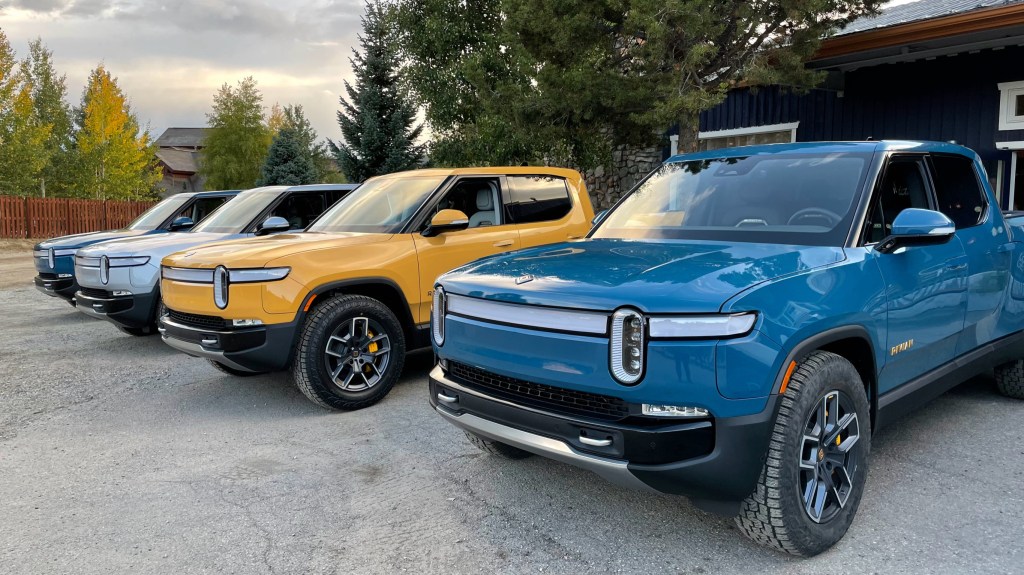
Electric vehicle startup Rivian, which started deliveries of its R1T pickup truck in September, released its filing to become a publicly traded company in the United States.
The S-1 document filed Friday with the U.S. Securities and Exchange Commission does not include terms for its offering.
The filing — one of the most anticipated of the year — shows a company burning through cash as it takes on the mammoth effort of designing, developing, producing and then selling electric vehicles. The S-1, the document where companies disclose financial data, risks and opportunities, also provides insight into its expansion, relationship with Amazon and spending projections.
Rivian reported a net loss of $426 million in 2019. Those losses more than doubled to $1 billion as the company built out its factory in Normal, Illinois, prepared to begin producing its R1T pickup truck and R1S SUV and expanded its workforce. Its S-1 states that it employed 6,274 people as of June 30. However, the company recently told TechCrunch it employs more than 8,000 people across several facilities in Arizona, California, Michigan, Illinois, Vancouver, Canada and the UK.
Rivian’s losses grew as it approached production of the R1T and R1S. The company posted a net loss of $994 million in the first half of 2021 alone, far more than double its $377 million net loss the company posted in the same period of 2020. Rivian’s R&D expenses are driving the spike in costs. The company spent $766 million on R&D in 2020. In the first half of 2021 the company spent $683 million on R&D.
Those costs are projected to grow. Rivian said it expects cumulative spending on capital expenditures to be about $8 billion through the end of 2023 as it invests in and builds out infrastructure, including additional manufacturing capacity, battery cell production, service operations, charging networks, retail and software development.
Rivian outlined its long-term business strategies, its plan to first sell its EVs and the United States and Canada and then soon expand to Western Europe. Sales in Asia will follow. Rivian said in its S-1 that it will build local facilities to support growth into those new markets.
Disrupt 2026: The tech ecosystem, all in one room
Your next round. Your next hire. Your next breakout opportunity. Find it at TechCrunch Disrupt 2026, where 10,000+ founders, investors, and tech leaders gather for three days of 250+ tactical sessions, powerful introductions, and market-defining innovation. Register now to save up to $400.
Save up to $300 or 30% to TechCrunch Founder Summit
1,000+ founders and investors come together at TechCrunch Founder Summit 2026 for a full day focused on growth, execution, and real-world scaling. Learn from founders and investors who have shaped the industry. Connect with peers navigating similar growth stages. Walk away with tactics you can apply immediately
Offer ends March 13.
Rivian also disclosed it had 48,390 preorders for its R1T pickup trucks and R1S SUVs in the United States and Canada as of September. Pre-orders, which requires a refundable $1,000 deposit, don’t always convert to sales. However, they can provide an indication of demand for the product.
The company said in its S-1 that it has also established a philanthropic mission called Forever. Initially, the company will fund the entity with shares of Rivian’s Class A common stock equal to 1% of the company’s outstanding equity immediately preceding the completion of this offering.
For a more detailed breakdown of the S-1, check out: