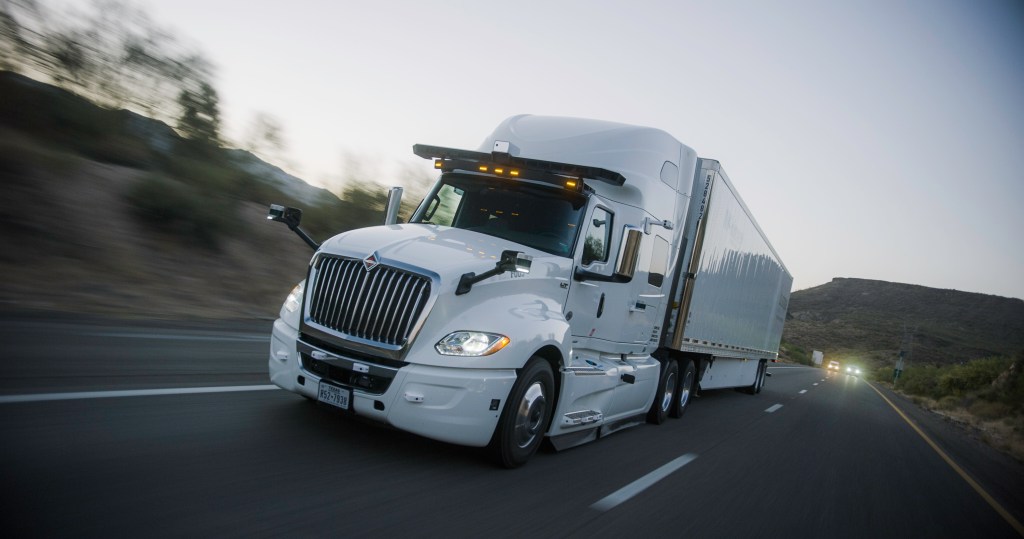
TuSimple, the self-driving truck company that went public earlier this year, has partnered with Ryder as part of its plan to build out a freight network that will support its autonomous trucking operations.
Under the deal announced this week, Ryder’s fleet maintenance facilities will act as terminals for TuSimple’s freight network. TuSimple’s so-called AFN, or autonomous freight network, is a collection of shipping routes and terminals designed for autonomous trucking operations that will extend across the United States by 2024. UPS, which took a minority stake in TuSimple before it went public, carrier U.S. Xpress, Penske Truck Leasing and Berkshire Hathaway’s grocery and food service supply chain company McLane Inc. were the inaugural partners in the network.
TuSimple’s AFN involves four pieces that includes its self-driving trucks, digital mapped routes, freight terminals and a system that will let customers monitor autonomous trucking operations and track their shipments in real time.
Ryder’s facilities will primarily serve as strategic terminals where TuSimple trucks can receive maintenance and have sensors used in the self-driving system calibrated, if needed. In some cases, the terminals might be used as a transfer hub for a smaller operator that might want to pick up cargo. But this is not meant to be a hub-to-hub system where its customers would come and pick up freight, according to TuSimple President and CEO Cheng Lu.
“These trucks need to be serviceable and maintainable and they need to have higher uptime, which is what every carrier cares about regardless of whether it is autonomous or not,” Lu said.
Small shippers and carriers might use these terminals to pick up and drop off freight. However, Lu stressed that in most cases, especially for large-scale operators like UPS, TuSimple will take the freight directly to the customer’s distribution centers. The Ryder facilities work as nodes, or stops, on its network to allow TuSimple to reach more customers over a larger geographic area, Lu added.
The partnership will start gradually. TuSimple has 50 autonomous trucks in its fleet that — along with a human safety operator behind the wheel — transport freight for customers in Arizona, New Mexico and Texas. The partnership will initially use Ryder’s facilities in these areas and eventually expand to the company’s 500 maintenance facilities in the United States.
Disrupt 2026: The tech ecosystem, all in one room
Your next round. Your next hire. Your next breakout opportunity. Find it at TechCrunch Disrupt 2026, where 10,000+ founders, investors, and tech leaders gather for three days of 250+ tactical sessions, powerful introductions, and market-defining innovation. Register now to save up to $400.
Save up to $300 or 30% to TechCrunch Founder Summit
1,000+ founders and investors come together at TechCrunch Founder Summit 2026 for a full day focused on growth, execution, and real-world scaling. Learn from founders and investors who have shaped the industry. Connect with peers navigating similar growth stages. Walk away with tactics you can apply immediately
Offer ends March 13.
TuSimple said it expects to expand operations to the East Coast, carrying freight between Phoenix and Orlando later this year. TuSimple has about 25 new trucks on order, which will be added to the fleet once they become available.
Kodiak Robotics’ founder says tight focus on autonomous trucks is working