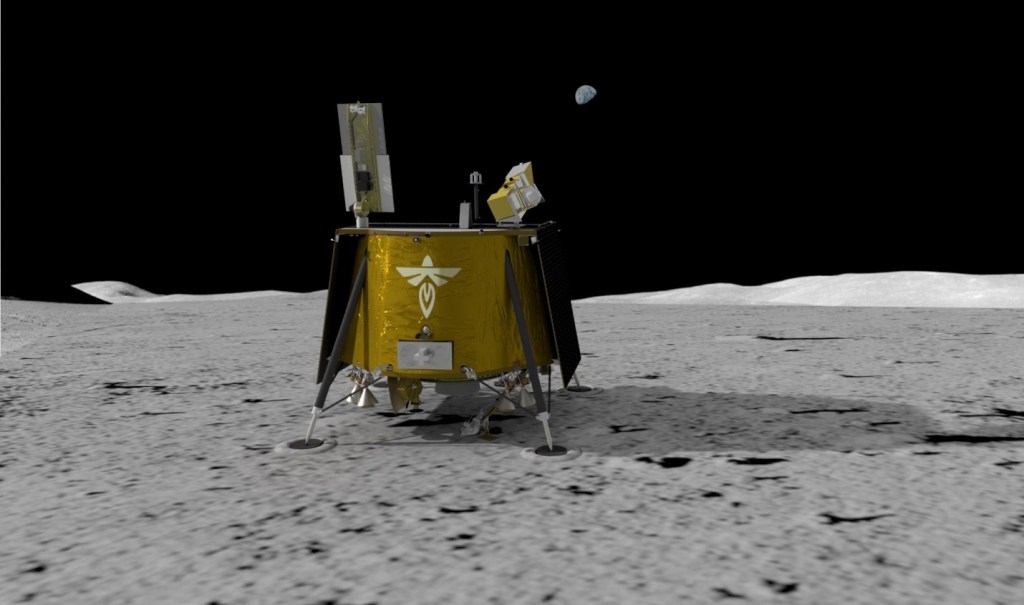
NASA has awarded Firefly Aerospace a $93.3 million contract to take a lunar lander module loaded with experiments to the surface of the moon. While the company will not be performing the launch itself, it will be providing the spacecraft and “Blue Ghost” lander for the 2023 mission.
The space agency made the award as part of its ongoing Commercial Lunar Payload Services, under which several other non-prime space companies have been selected for similar work: Blue Origin, Astrobotic, Masten and so on.
Rocket startup Firefly signs satellite constellation launch mission with Satlantis
This particular contract was first publicized to its CLPS partners back in September, which would have submitted bids for the project; Firefly clearly carried the day.
“We’re excited another CLPS provider has won its first task order award,” said NASA associate administrator for science Thomas Zurbuchen in a release announcing the contract. The last few years have seen many such firsts as NASA has increasingly embraced the commercial sector in providing everything from launch services to satellite and spacecraft manufacturing.
It’s not exactly Firefly’s first order from NASA, though: Its national security subsidiary Firefly Black (ominous) will be launching two cubesats for the Venture Class Launch Service Demo-2 mission. But this is larger and more complex by a huge margin (not to mention more expensive).
Disrupt 2026: The tech ecosystem, all in one room
Your next round. Your next hire. Your next breakout opportunity. Find it at TechCrunch Disrupt 2026, where 10,000+ founders, investors, and tech leaders gather for three days of 250+ tactical sessions, powerful introductions, and market-defining innovation. Register now to save up to $400.
Save up to $300 or 30% to TechCrunch Founder Summit
1,000+ founders and investors come together at TechCrunch Founder Summit 2026 for a full day focused on growth, execution, and real-world scaling. Learn from founders and investors who have shaped the industry. Connect with peers navigating similar growth stages. Walk away with tactics you can apply immediately
Offer ends March 13.
This will be the maiden lunar voyage for Firefly’s Blue Ghost lander, which it’s been working on for the last few years in anticipation of renewed interest in the moon. It will hold the 10 scientific payloads, which NASA describes here, including a new laser reflector array and an experimental radiation-tolerant computer. There’s a lot to be loaded up, but Blue Ghost should have 50kg of space left over for anyone else who wants a ride to the moon.
Everything is going to Mare Crisium, a basin on the “light” or near side of the moon, where hopefully they will contribute valuable observations and experiments to inform future visits to and habitation on the moon.
Firefly will also be providing the spacecraft that will take the lander into lunar space, and will be responsible for getting it off the Earth in the first place — the company told me they’re evaluating options for that. By the time 2023 rolls around there should be plenty of rides to choose from. Firefly’s own Alpha launch vehicle should have its first flight in March, and the more powerful Beta may be flying by 2023, though neither is ready to commit to a lunar insertion orbit mission today.
NASA wants new and innovative storytelling tech to document its Artemis moon missions