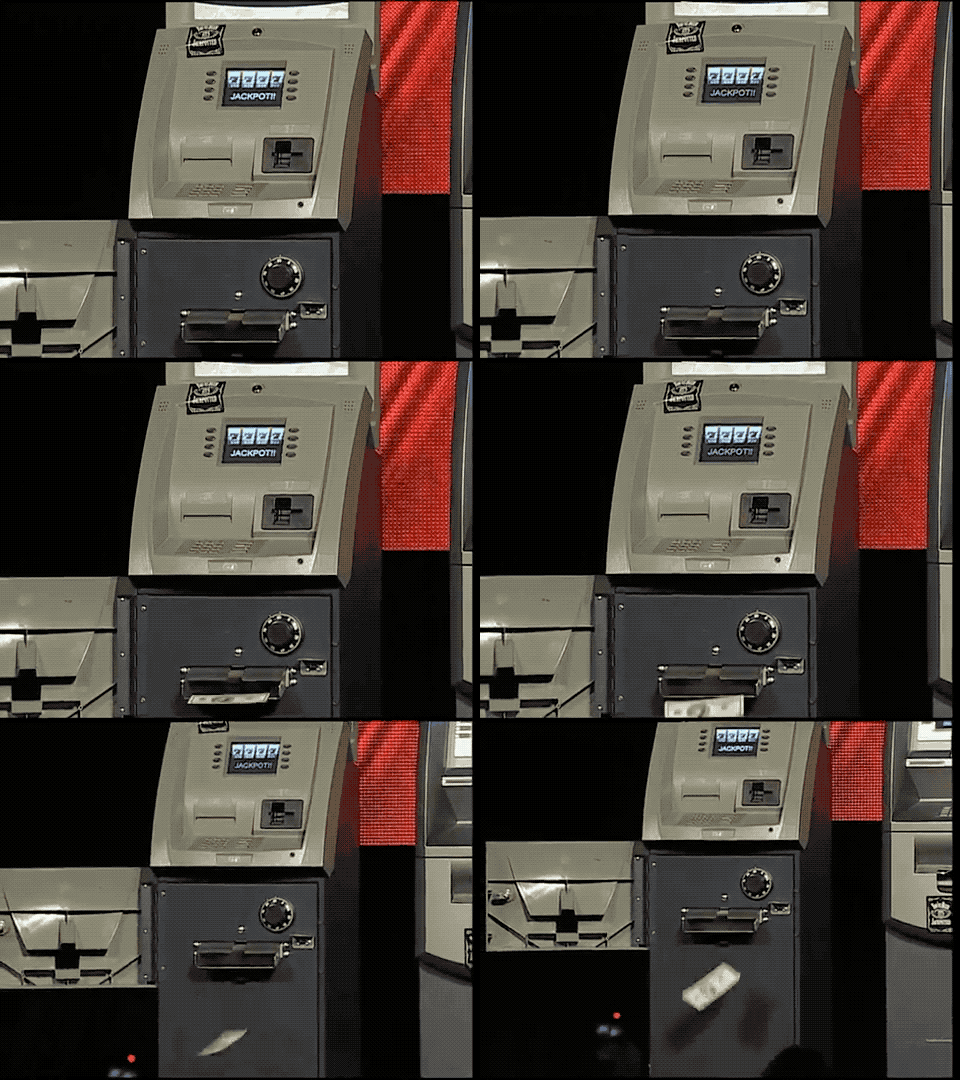
In 2010, the late Barnaby Jack, a world-renowned security researcher, hacked an ATM live onstage at the Black Hat conference by tricking the cash dispenser into spitting out a stream of dollar bills. The technique was appropriately named “jackpotting.”
A decade on from Jack’s blockbuster demo, security researchers are presenting two new vulnerabilities in Nautilus ATMs, albeit virtually, thanks to the coronavirus pandemic.
Security researchers Brenda So and Trey Keown at New York-based security firm Red Balloon say their pair of vulnerabilities allowed them to trick a popular standalone retail ATM, commonly found in stores rather than at banks, into dispensing cash at their command.
A hacker would need to be on the same network as the ATM, making it more difficult to launch a successful jackpotting attack. But their findings highlight that ATMs often have vulnerabilities that lie dormant for years — in some cases since they were first built.
So and Keown said their new vulnerabilities target the Nautilus ATM’s underlying software, a decade-old version of Windows that is no longer supported by Microsoft. To begin with, the pair bought an ATM to examine. But with little documentation, the duo had to reverse-engineer the software inside to understand how it worked.
The first vulnerability was found in a software layer known as XFS — or Extensions for Financial Services — which the ATM uses to talk to its various hardware components, such as the card reader and the cash dispensing unit. The bug wasn’t in XFS itself, rather in how the ATM manufacturer implemented the software layer into its ATMs. The researchers found that sending a specially crafted malicious request over the network could effectively trigger the ATM’s cash dispenser and dump the cash inside, Keown told TechCrunch.
The second vulnerability was found in the ATM’s remote management software, an in-built tool that lets owners manage their fleet of ATMs by updating the software and checking how much cash is left. Triggering the bug would grant a hacker access to a vulnerable ATM’s settings.
Disrupt 2026: The tech ecosystem, all in one room
Your next round. Your next hire. Your next breakout opportunity. Find it at TechCrunch Disrupt 2026, where 10,000+ founders, investors, and tech leaders gather for three days of 250+ tactical sessions, powerful introductions, and market-defining innovation. Register now to save up to $400.
Save up to $300 or 30% to TechCrunch Founder Summit
1,000+ founders and investors come together at TechCrunch Founder Summit 2026 for a full day focused on growth, execution, and real-world scaling. Learn from founders and investors who have shaped the industry. Connect with peers navigating similar growth stages. Walk away with tactics you can apply immediately
Offer ends March 13.
So told TechCrunch it was possible to switch the ATM’s payment processor with a malicious, hacker-controlled server to siphon off banking data. “By pointing an ATM to a malicious server, we can extract credit card numbers,” she said.
Bloomberg first reported the vulnerabilities last year when the researchers privately reported their findings to Nautilus. About 80,000 Nautilus ATMs in the U.S. were vulnerable prior to the fix, Bloomberg reported. A Nautilus spokesperson would not confirm the figure.
Successful jackpotting attacks are rare but not unheard of. In recent years, hackers have used a number of techniques. In 2017, an active jackpotting group was discovered operating across Europe, netting millions of euros in cash.
More recently, hackers have stolen proprietary software from ATM manufacturers to build their own jackpotting tools.
Send tips securely over Signal and WhatsApp to +1 646-755-8849 or send an encrypted email to: zack.whittaker@protonmail.com