Prosthetic limbs are getting better, but not as quickly as you’d think. They’re not as smart as our real limbs, which (directed by the brain) do things like automatically stretch out to catch ourselves when we fall. This particular “stumble reflex” was the subject of an interesting study at Vanderbilt that required its subjects to fall down… a lot.
The problem the team is aiming to help alleviate is simply that users of prosthetic limbs fall, as you might guess, more than most, and when they do fall, it can be very difficult to recover, because an artificial leg — especially for above-the-knee amputations — doesn’t react the same way a natural leg would.
The idea, explained lead researcher and mechanical engineering Professor Michael Goldfarb, is to determine what exactly goes into a stumble response and how to recreate that artificially.
Prototype prosthesis proffers proper proprioceptive properties
“An individual who stumbles will perform different actions depending on various factors, not all of which are well known. The response changes, because the strategy that is most likely to prevent a fall is highly dependent on the ‘initial conditions’ at the time of stumble,” he told TechCrunch in an email. “We are hoping to construct a model of which factors determine the nature of the stumble response, so when a stumble occurs, we can use the various sensors on a robotic prosthetic leg to artificially reconstruct the reflex in order to provide a response that is effective and consistent with the biological reflex loop.”
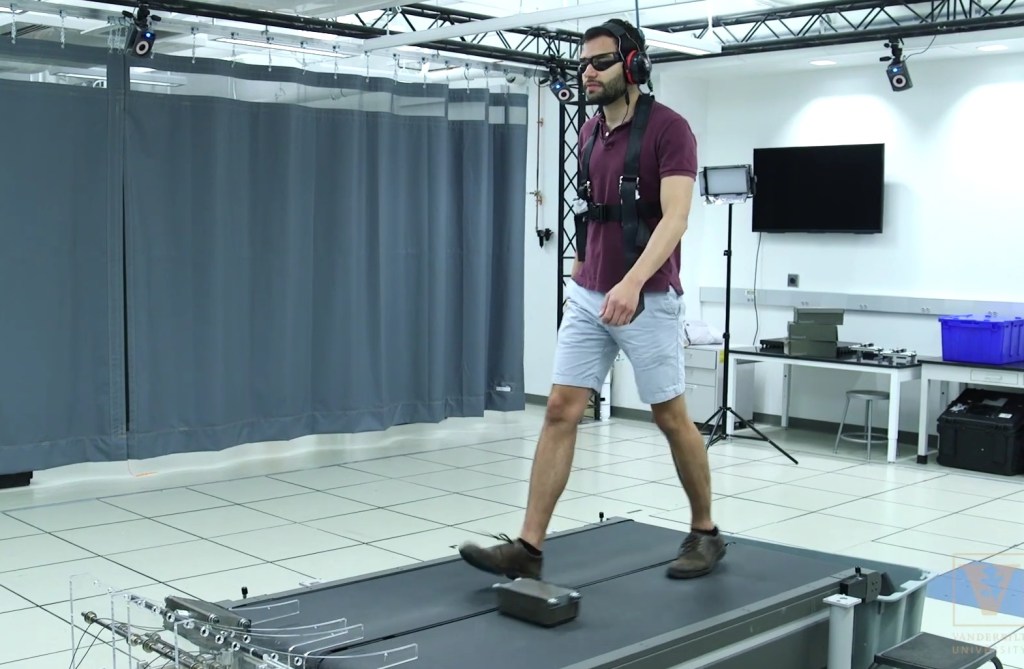
The experimental setup looked like this. Subjects were put on a treadmill and told to walk forward normally; a special pair of goggles prevented them from looking down, arrows on a display kept them going straight, and a simple mental task (count backwards by sevens) kept their brain occupied.
Disrupt 2026: The tech ecosystem, all in one room
Your next round. Your next hire. Your next breakout opportunity. Find it at TechCrunch Disrupt 2026, where 10,000+ founders, investors, and tech leaders gather for three days of 250+ tactical sessions, powerful introductions, and market-defining innovation. Register now to save up to $400.
Save up to $300 or 30% to TechCrunch Founder Summit
1,000+ founders and investors come together at TechCrunch Founder Summit 2026 for a full day focused on growth, execution, and real-world scaling. Learn from founders and investors who have shaped the industry. Connect with peers navigating similar growth stages. Walk away with tactics you can apply immediately
Offer ends March 13.
Meanwhile an “obstacle delivery apparatus” bode its time, waiting for the best opportunity to slip a literal stumbling block onto the treadmill for the person to trip over.
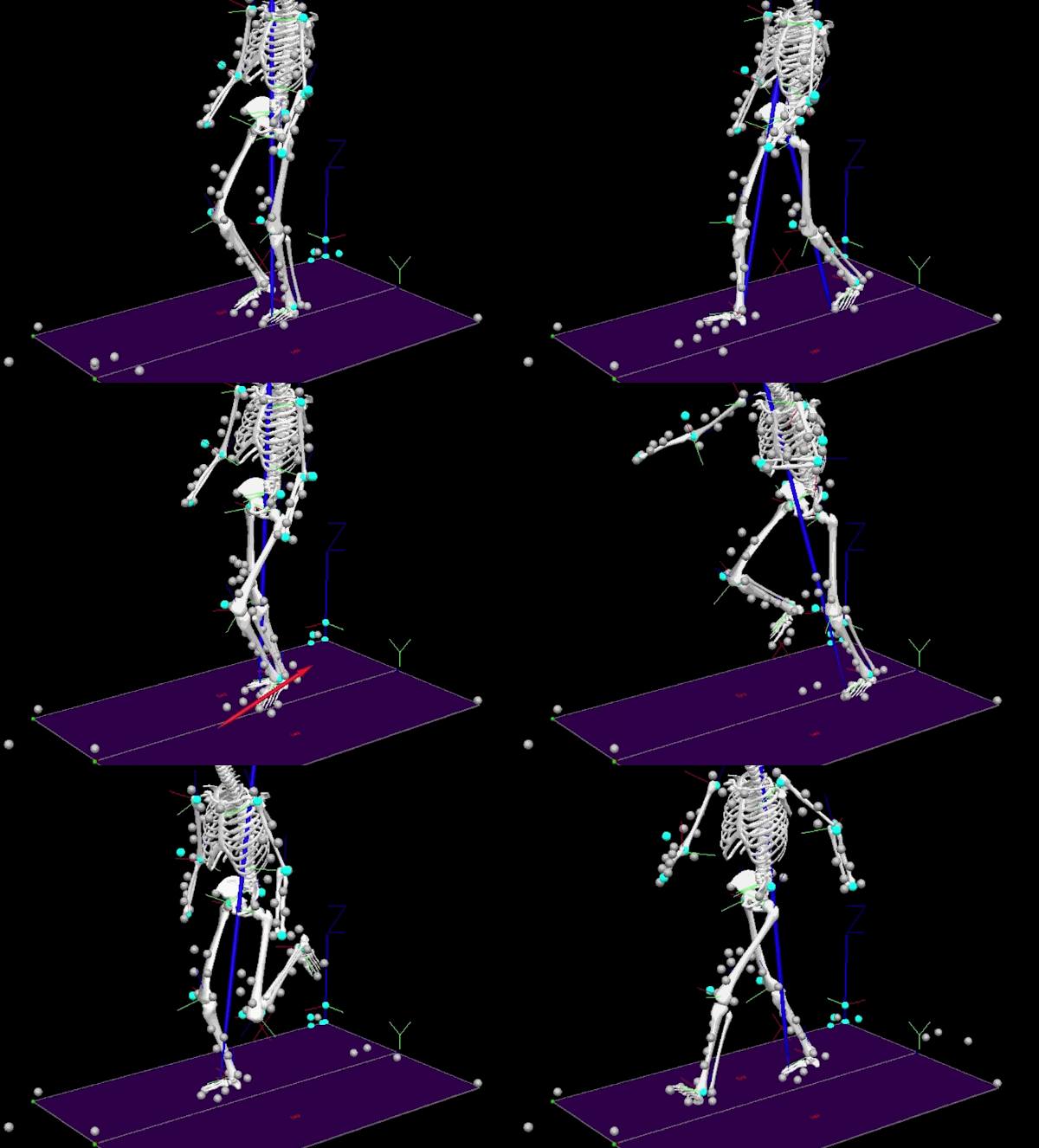 When this happened, the person inevitably stumbled, though a harness prevented them from actually falling and hurting themselves. But as they stumbled, their movements were captured minutely by a motion capture rig.
After 196 stumbling blocks and 190 stumbles, the researchers had collected a great deal of data on how exactly people move to recover from a stumble. Where do their knees go relative to their ankles? How do they angle their feet? How much force is taken up by the other foot?
Exactly how this data would be integrated with a prosthesis is highly dependent on the nature of the artificial limb and the conditions of the person using it. But having this data, and perhaps feeding it to a machine learning model, will help expose patterns that can be used to inform emergency prosthetic movements.
It could also be used for robotics: “The model could be used directly to program reflexes in a biped,” said Goldfarb. Those human-like motions we see robots undertaking could be even more human when directly based on the original. There’s no rush there — they might be a little too human already.
The research describing the system and the data set, which they’re releasing for free to anyone who’d like to use it, appeared in the Journal of NeuroEngineering and Rehabilitation.