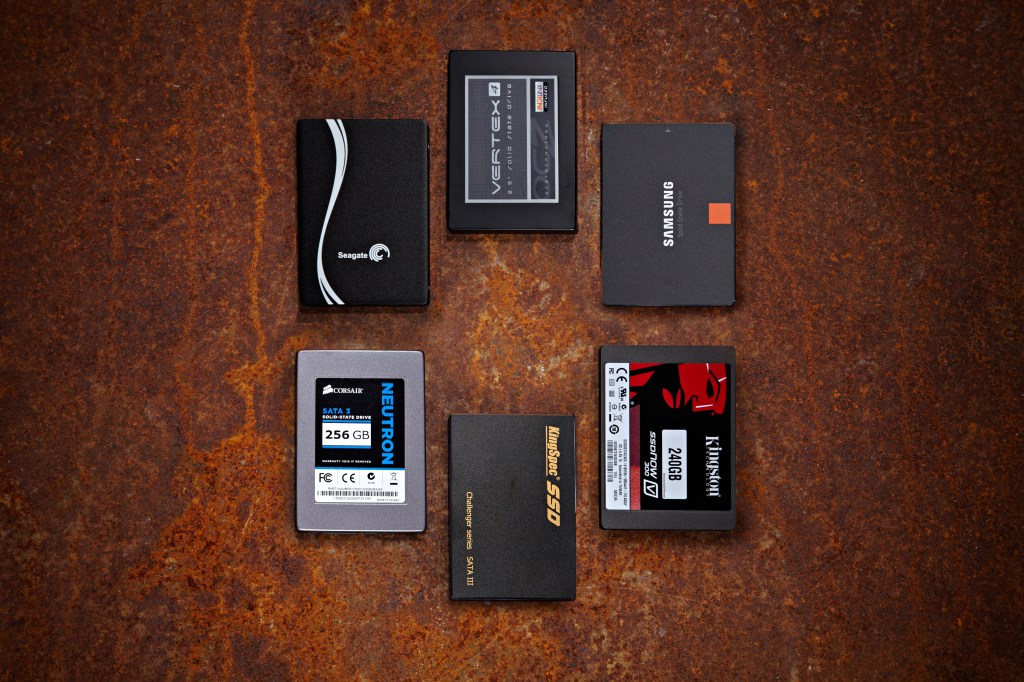
Researchers at Radboud University have found critical security flaws in several popular Crucial and Samsung solid state drives (SSDs), which they say can be easily exploited to recover encrypted data without knowing the password.
The researchers, who detailed their findings in a new paper out Monday, reverse engineered the firmware of several drives to find a “pattern of critical issues” across the device makers.
In the case of one drive, the master password used to decrypt the drive’s data was just an empty string and could be easily exploiting by flipping a single bit in the drive’s memory. Another drive could be unlocked with “any password” by crippling the drive’s password validation checks.
That wouldn’t be much of a problem if an affected drive also used software encryption to secure its data. But the researchers found that in the case of Windows computers, often the default policy for BitLocker’s software-based drive encryption is to trust the drive — and therefore rely entirely on a device’s hardware encryption to protect the data. Yet, as the researchers found, if the hardware encryption is buggy, BitLocker isn’t doing much to prevent data theft.
In other words, users “should not rely solely on hardware encryption as offered by SSDs for confidentiality,” the researchers said.
Alan Woodward, a professor at the University of Surrey, said that the greatest risk to users is the drive’s security “failing silently.”
“You might think you’ve done the right thing enabling BitLocker but then a third-party fault undermines your security, but you never know and never would know,” he said.
Disrupt 2026: The tech ecosystem, all in one room
Your next round. Your next hire. Your next breakout opportunity. Find it at TechCrunch Disrupt 2026, where 10,000+ founders, investors, and tech leaders gather for three days of 250+ tactical sessions, powerful introductions, and market-defining innovation. Register now to save up to $400.
Save up to $300 or 30% to TechCrunch Founder Summit
1,000+ founders and investors come together at TechCrunch Founder Summit 2026 for a full day focused on growth, execution, and real-world scaling. Learn from founders and investors who have shaped the industry. Connect with peers navigating similar growth stages. Walk away with tactics you can apply immediately
Offer ends March 13.
Matthew Green, a cryptography professor at Johns Hopkins, described the BitLocker flaw in a tweet as “like jumping out of a plane with an umbrella instead of a parachute.”
The researchers said that their findings are not yet finalized — pending a peer review. But the research was made public after disclosing the bugs to the drive makers in April.
Crucial’s MX100, MX200 and MX300 drives, Samsung’s T3 and T5 USB external disks and Samsung 840 EVO and 850 EVO internal hard disks are known to be affected, but the researchers warned that many other drives may also be at risk.
The researchers criticized the device makers’ proprietary and closed-source cryptography that they said — and proved — is “often shown to be much weaker in practice” than their open-source and auditable cryptographic libraries. “Manufacturers that take security seriously should publish their crypto schemes and corresponding code so that security claims can be independently verified,” they wrote.
The researchers recommend using software-based encryption, like the open-source software VeraCrypt.
In an advisory, Samsung also recommended that users install encryption software to prevent any “potential breach of self-encrypting SSDs.” Crucial’s owner Micron is said to have a fix on the way, according to an advisory by the Netherlands’ National Cyber Security Center, but did not say when.
Micron did not immediately respond to a request for comment.
Smart home tech makers don’t want to say if the feds come for your data