

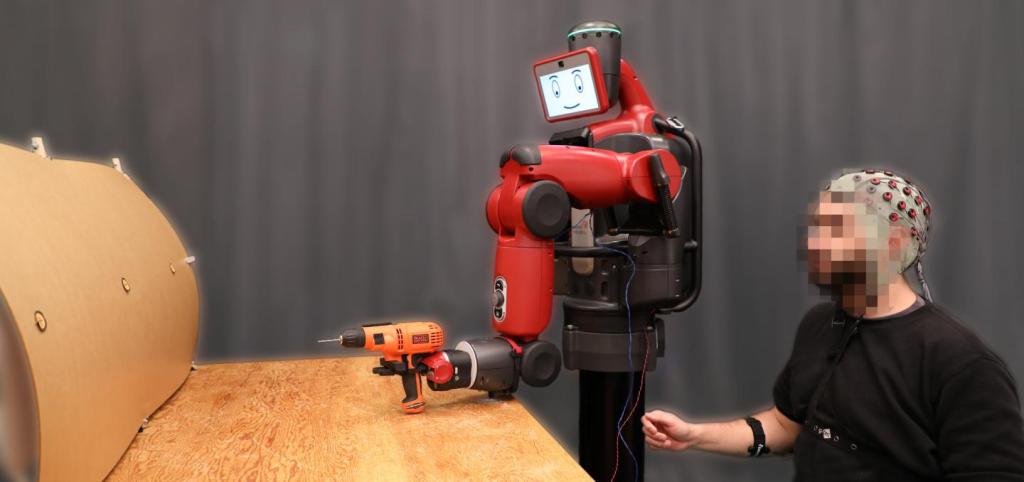
How do you tell your robot not do something that could be catastrophic? You could give it a verbal or programmatic command or you could have it watch your brain for signs of distress and have it stop itself. That’s what researchers at MIT’s robotics research lab have done with a system that is wired to your brain and tells robots how to do their job.
The initial system is fairly simple. A scalp EEG and EMG system is connected to a Baxter work robot and lets a human wave or gesture when the robot is doing something that it shouldn’t be doing. For example, the robot could regularly do a task – drilling holes, for example – but when it approaches an unfamiliar scenario the human can gesture at the task that should be done.
“By looking at both muscle and brain signals, we can start to pick up on a person’s natural gestures along with their snap decisions about whether something is going wrong,” said PhD candidate Joseph DelPreto. “This helps make communicating with a robot more like communicating with another person.”
Because the system uses nuances like gestures and emotional reactions you can train robots to interact with humans with disabilities and even prevent accidents by catching concern or alarm before it is communicated verbally. This lets workers stop a robot before it damages something and even help the robot understand slight changes to its tasks before it begins.
In their tests the team trained Baxter to drill holes in an airplane fuselage. The task changed occasionally and a human standing nearby was able to gesture to the robot to change position before it drilled, essentially training it to do new tasks in the midst of its current task. Further, there was no actual programming involved on the human’s part, just a suggestion that the robot move the drill left or right on the fuselage. The most important thing? Humans don’t have to think in a special way or train themselves to interact with the machine.
“What’s great about this approach is that there’s no need to train users to think in a prescribed way,” said DelPreto. “The machine adapts to you, and not the other way around.”
The team will present their findings at the Robotics: Science and Systems (RSS) conference.
Disrupt 2026: The tech ecosystem, all in one room
Your next round. Your next hire. Your next breakout opportunity. Find it at TechCrunch Disrupt 2026, where 10,000+ founders, investors, and tech leaders gather for three days of 250+ tactical sessions, powerful introductions, and market-defining innovation. Register now to save up to $400.
Save up to $300 or 30% to TechCrunch Founder Summit
1,000+ founders and investors come together at TechCrunch Founder Summit 2026 for a full day focused on growth, execution, and real-world scaling. Learn from founders and investors who have shaped the industry. Connect with peers navigating similar growth stages. Walk away with tactics you can apply immediately
Offer ends March 13.
[youtube=https://www.youtube.com/watch?v=_Or8Lt3YtEA&feature=youtu.be]

