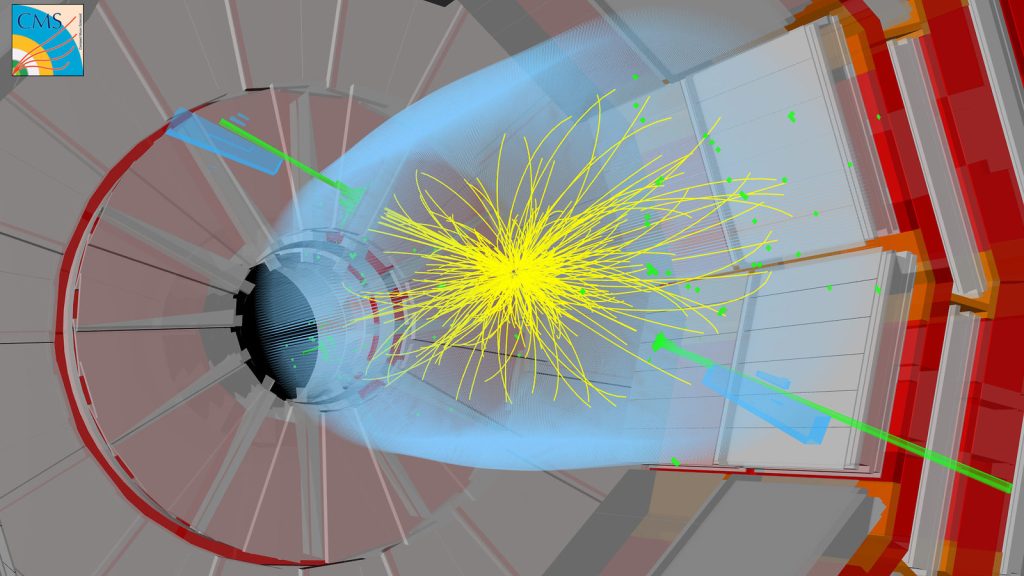
The volume of data particle physicists have to sort through at the Large Hadron Collider is staggering, and it’s about to increase by an order of magnitude. To cope with this torrent of data, CERN is turning to machine learning, offering prizes for AI models that can cut through the clutter and help make the next breakthrough.
Inside the massive detectors that dot the rings of the LHC, protons accelerated to near light speed smash into each other with incredible energy and produce a fountain of exotic, short-lived particles that impact on sensors lining the walls. Improvements being made to the magnetic fields guiding these protons around the ring mean that where once you could expect a couple dozen collisions to draw data from, soon there may be hundreds.
5 years after the Higgs boson, the Large Hadron Collider is just getting started
Great for the scientists, but with more collisions comes more data, in this case an order of magnitude more. The old methods of sorting and categorizing the data are too slow, researchers told Nature. So they’re doing what any modern data scientist would do when faced with a massive set of noisy data: hand it over to the AIs.
I use the term loosely, of course — machine learning models are just really great at chewing through reams of data in search of what they’ve been trained to find. Medicine, astronomy and, of course, psychology (courtesy of Facebook) have all been advanced by this convenient ability to separate the statistical wheat from the chaff. Particle physics is just another example of it.
A little healthy competition, as always, is a good way to jump-start the field. So CERN established TrackML, a relatively low-key contest in which physicists and data scientists can download gigs of real collider data and train up models to classify it correctly. Of course, there are terabytes available for the picking, but you’ll want to use this particular data set.
Disrupt 2026: The tech ecosystem, all in one room
Your next round. Your next hire. Your next breakout opportunity. Find it at TechCrunch Disrupt 2026, where 10,000+ founders, investors, and tech leaders gather for three days of 250+ tactical sessions, powerful introductions, and market-defining innovation. Register now to save up to $400.
Save up to $300 or 30% to TechCrunch Founder Summit
1,000+ founders and investors come together at TechCrunch Founder Summit 2026 for a full day focused on growth, execution, and real-world scaling. Learn from founders and investors who have shaped the industry. Connect with peers navigating similar growth stages. Walk away with tactics you can apply immediately
Offer ends March 13.
The prize pool is relatively small, with a total of $25,000 available to the winners. Perhaps they used up all their money on… you know, upgrading the world’s biggest particle collider with state of the art cryomagnets.
There’s no entry fee, so if you’re interested in giving it a shot, head over to Kaggle, where the contest is hosted, and download your own copy of the data. You’ve got plenty of time — submissions are due in August. Oh, and anything you submit will be open sourced, so don’t worry that they’re going to commercialize your algorithm.