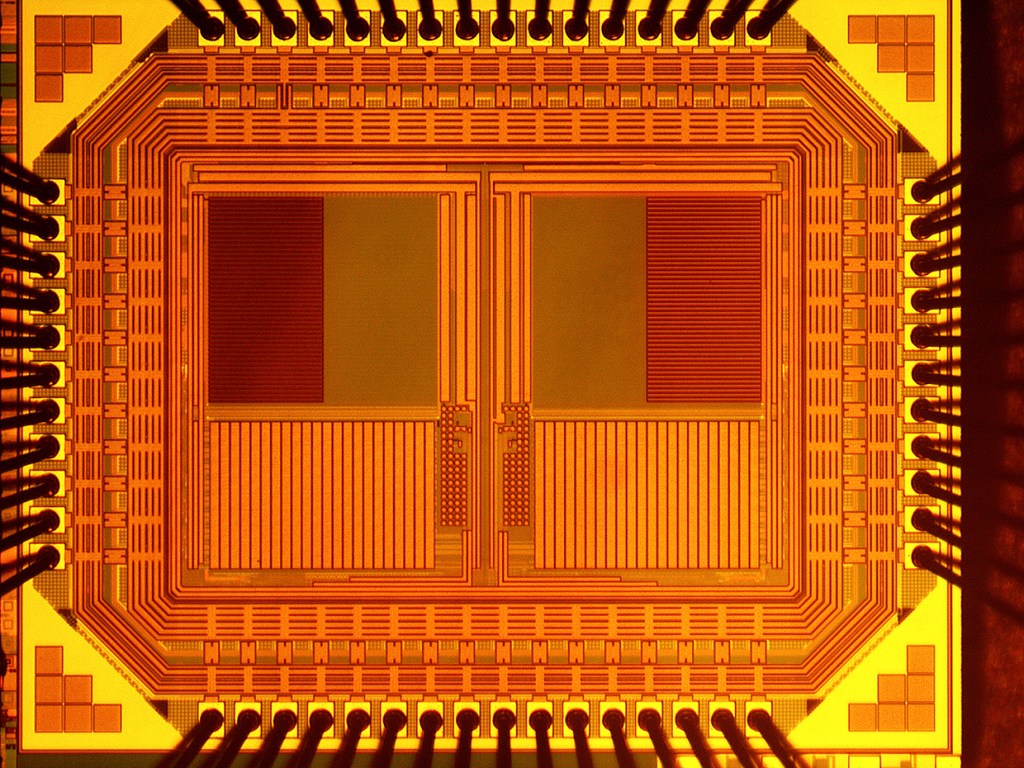
As if there weren’t already cameras enough in this world, researchers created a new type that is both microscopic and self-powered, making it possible to embed just about anywhere and have it work perpetually. It’s undoubtedly cool technology, but it’s probably also going to cause a spike in tinfoil sales.
Engineers have previously investigated the possibility of having a camera sensor power itself with the same light that falls on it. After all, it’s basically just two different functions of a photovoltaic cell — one stores the energy that falls on it while the other records how much energy fell on it.
The problem is that if you have a cell doing one thing, it can’t do the other. So if you want to have a sensor of a certain size, you have to dedicate a certain amount of that real estate to collecting power, or else swap the cells rapidly between performing the two tasks.
Euisik Yoon and post-doc Sung-Yun Park at the University of Michigan came up with a solution that avoids both these problems. It turns out that photosensitive diodes aren’t totally opaque — in fact, quite a lot of light passes right through them. So putting the solar cell under the image sensor doesn’t actually deprive it of light.
That breakthrough led to the creation of this “simultaneous imaging and energy harvesting” sensor, which does what it says on the tin.
The prototype sensor they built is less than a square millimeter, and fully self-powered in sunlight. It captured images at up to 15 frames per second of pretty reasonable quality:

In the paper, the researchers point out that they could easily produce better images with a few tweaks to the sensor, and Park tells IEEE Spectrum that the power consumption of the chip is also not optimized — so it could also operate at higher framerates or lower lighting levels.
Disrupt 2026: The tech ecosystem, all in one room
Your next round. Your next hire. Your next breakout opportunity. Find it at TechCrunch Disrupt 2026, where 10,000+ founders, investors, and tech leaders gather for three days of 250+ tactical sessions, powerful introductions, and market-defining innovation. Register now to save up to $400.
Save up to $300 or 30% to TechCrunch Founder Summit
1,000+ founders and investors come together at TechCrunch Founder Summit 2026 for a full day focused on growth, execution, and real-world scaling. Learn from founders and investors who have shaped the industry. Connect with peers navigating similar growth stages. Walk away with tactics you can apply immediately
Offer ends March 13.
Ultimately the sensor could be essentially a nearly invisible camera that operates forever with no need for a battery or even wireless power. Sounds great!
In order for this to be a successful spy camera, of course, it needs more than just an imaging component — a storage and transmission medium are necessary for any camera to be useful. But microscopic versions of those are also in development, so putting them together is just a matter of time and effort.
The team published their work this week in the journal IEEE Electron Device Letters.