Automated inspection company Avitas Systems, which is a GE Venture company, is using Nvidia’s DGX-1 and DGX Station to train its neural-network-based artificial intelligence to be able to quickly and consistently identify defects in industrial equipment.
Avitas Systems uses a range of robotic equipment to monitor things like oil and gas pipelines, coolant towers and other crucial equipment, including aerial and underwater drones – and Nvidia’s help means it can create software that can help these bots spot the slightest bit of corrosion or variance in equipment before it becomes a dangerous problem.
Alex Tepper, Avitas founder and head of corporate and business development, explained in an interview that GE has been helping customers with industrial inspections for a long time, and has found that these customers are spending hundreds of millions of dollars on inspections that involve a person driving out to, or flying a helicopter above an asset. These aren’t methods that generate fool-proof results, of course, and there’s a lot that can’t be seen reliably with the naked eye.
“We’re analyzing the results from those robotics to do automated defect recognition, which is a fancy way of saying interpreting those sensor results, applying AI to them, so that we can figure out if there are any defects being sensed, whether it’s corrosion, micro-fractures, hot and cold spots – oftentimes defects that the human eye can’t see.”
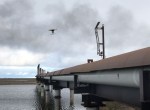


Additionally, Avitas can provide reliable replication of observation conditions with automated inspection methods – robots can take the same photograph or sensor reading from the same perspective over and over again. And they can help shift defect monitoring from a time-based operation to a risk-based one: Instead of sending out a person to check an asset on a pre-defined schedule, automated observation can target high-risk assets and keep them under pretty much constant watch.
Nvidia’s role in all this is processing of the resulting data via its DGX-1 supercomputer, and also through its DGX Station, which provides unique capabilities by offering analysis and processing capabilities at the edge – decoupled from the data center. Tepper says that more and more of their work involves running AI applications in areas where there isn’t a reliable connection to a central server – or even any connection at all, in some cases.
The DGX Station puts hundreds of CPUs in a power-efficient, portable form factor, and it’s just the start for Nvidia’s ambitions to bring supercomputing power to the field.
Disrupt 2026: The tech ecosystem, all in one room
Your next round. Your next hire. Your next breakout opportunity. Find it at TechCrunch Disrupt 2026, where 10,000+ founders, investors, and tech leaders gather for three days of 250+ tactical sessions, powerful introductions, and market-defining innovation. Register now to save up to $400.
Save up to $300 or 30% to TechCrunch Founder Summit
1,000+ founders and investors come together at TechCrunch Founder Summit 2026 for a full day focused on growth, execution, and real-world scaling. Learn from founders and investors who have shaped the industry. Connect with peers navigating similar growth stages. Walk away with tactics you can apply immediately
Offer ends March 13.
“Avitas started with a prototype version of our station, and soon they’ll be getting an upgrade to our DGX Station with Volta [launched in May], and that’ll be a huge performance gain,” explained Nvidia GM of DGX Systems Jim Hugh. “I think Alex and team are going to see a 3x performance in the activity there at a minimum, and it could even be greater for the inference activity they’re seeing.”