
One-third of all link clicks on Facebook already go to its self-hosted Instant Articles. Facebook claims they drive more referral traffic click-for-click because people don’t abandon them mid-click as they do with slow-loading mobile websites. Now Facebook is teaming up with Nielsen to prove that individual publishers benefit when they post with the Instant Articles format.
Today Facebook is launching an analytics comparison tool for Instant Articles publishers. It looks at the referral traffic from a test group of people who see Instant Article versions of links, and a control group that sees mobile web versions. Facebook hopes publishers will see for themselves that they get more traffic from Instant Articles. The tool is now rolling out to publishers who’ve posted enough of both formats, and Facebook plans to add more metrics to the tool in the future.
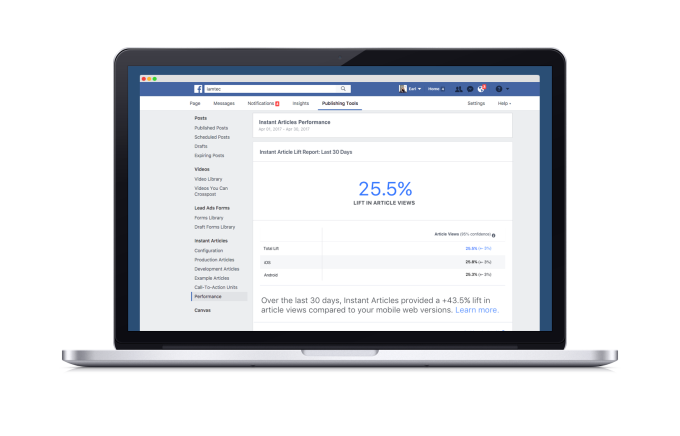
Facebook says that, on average, here’s how much more people click and read Instant Articles over mobile web in different parts of the world:
- U.S. and Canada click and read over 25 percent more
- Europe clicks and reads over 30 percent more
- Middle East and North Africa click and read 80 percent more
- Southeast Asia reads and clicks 60 percent more
- Latin America reads and clicks 60 percent more
- India reads and clicks over 75 percent more
That leaves out of whether these Instant Articles monetize better. That’s something that publishers are increasingly worried about — and with good reason.
Facebook launched Instant Articles in 2015 with a sterilized style, tons of restrictions on how many ads they could show and no way to include subscription purchase, newsletter sign-up or recirculation units that drive revenue. That year, I warned publishers they risked becoming ghostwriters feeding dumb content into Facebook’s smart pipe, with no differentiation between publishers or opportunities to build long-term relationships with loyal readers. You can watch my rant about the problem below.
[tc_aol_on code=”519169123″]
Disrupt 2026: The tech ecosystem, all in one room
Your next round. Your next hire. Your next breakout opportunity. Find it at TechCrunch Disrupt 2026, where 10,000+ founders, investors, and tech leaders gather for three days of 250+ tactical sessions, powerful introductions, and market-defining innovation. Register now to save up to $400.
Save up to $300 or 30% to TechCrunch Founder Summit
1,000+ founders and investors come together at TechCrunch Founder Summit 2026 for a full day focused on growth, execution, and real-world scaling. Learn from founders and investors who have shaped the industry. Connect with peers navigating similar growth stages. Walk away with tactics you can apply immediately
Offer ends March 13.
Recently, Facebook has been working to fix some of those problems. It let publishers start showing more ads, introduced Page Like and email sign-up buttons and is now testing recirculation units so news outlets can drive readers from one article to another. Facebook plans to start testing a paid subscription paywall feature in the fall.
Still, the News Media Alliance representing 2,000 newspapers, including The New York Times and The Wall Street Journal, recently asked Congress for anti-trust exemption so they could collectively bargain with Facebook and Google over who gets ad revenue. Money that used to go to buy ads on publishers’ sites is rolling up to the content aggregators through which people find their news. That threatens to defund newsrooms in favor of social and search platforms.
With the new tool, publishers should be able to compare the referral traffic and their monetization of Instant Articles versus mobile web, and see which ends up making them more money overall. That could inform them about whether Instant Articles are a deal with the devil or a match made in heaven.