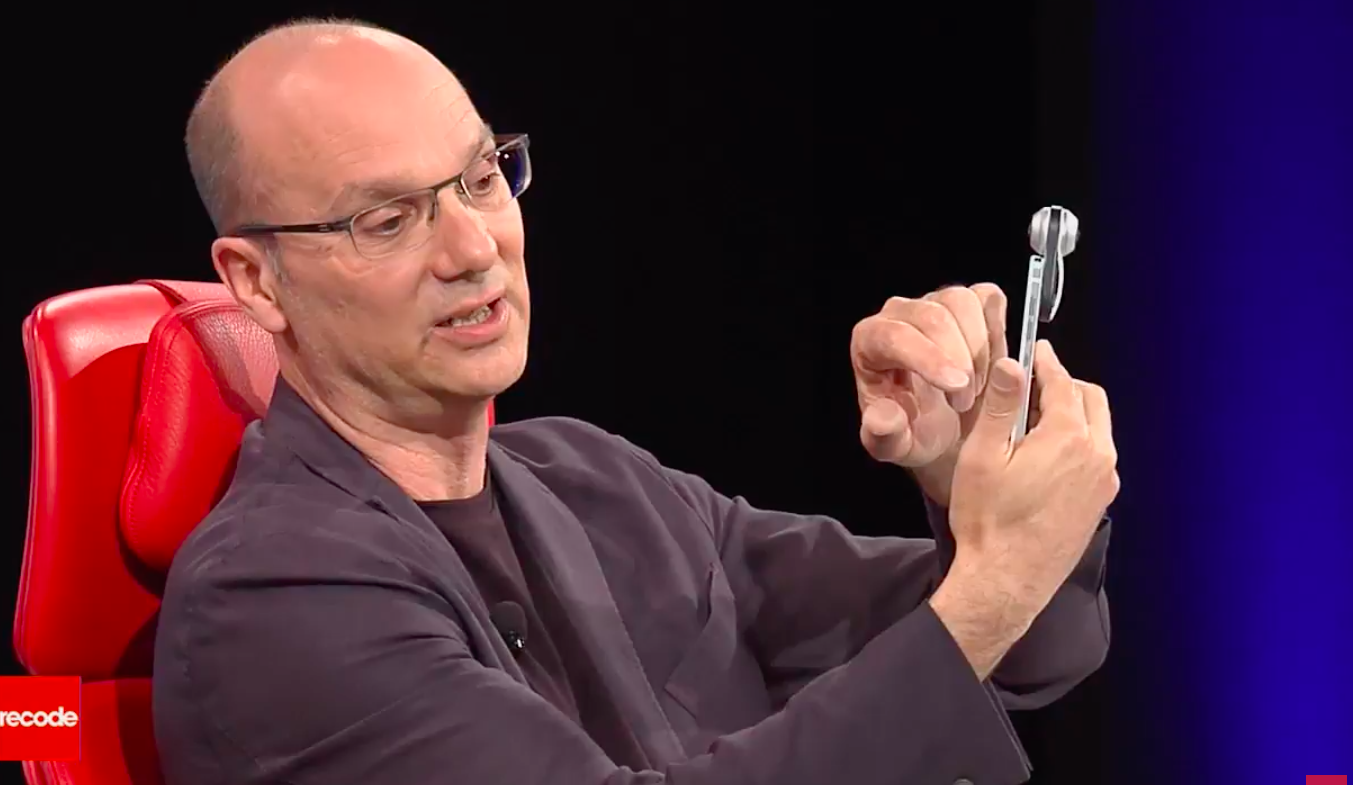
Andy Rubin’s appearance at the Code Conference last night went a ways toward answering some lingering questions about his new company, Essential. But the conversation primarily centered around the startup’s upcoming phone — Rubin left the dialogue around the company’s take on a smart phone hub, Home, intentionally vague.
But the CEO did take the opportunity to highlight some of the broader ambitions for the project. Home is, in Rubin’s estimation, more than just another Amazon Echo competitor. It’s an ambitious attempt to create a unified hub for all of the different smart assistants vying for market share. One smart hub to rule them all.
At the heart of the play is Ambient, an open-source operating system designed to accommodate third-party offerings like Alexa and Google Assistant. The echoes of Android are pretty hard to miss.
It’s telling that the company went out of its way to build a new operating system for its second hardware product, even as it opted to stick with vanilla Android on its phone. Building a new OS is an ambitious project for a startup – even one with, as Rubin disclosed onstage, “hundreds of millions” in investment.
The reason the company stuck with Android for the phone is pretty simple: Rubin already built the phone operating system he wanted. But even with Google’s efforts in the home automation space, there’s really no Android equivalent for the smart home.
“We very much believe that there has never been premium craftsmanship that has unleashed the full potential of the Android operating system,” President and COO Niccolo de Masi told TechCrunch during an interview following the event. “We believe that we’re in the best position to do that unleashing. And in the home, there is no horizontal, open-source ecosystem focused on interoperability. And we also think we have a lot of experience with that.”
Disrupt 2026: The tech ecosystem, all in one room
Your next round. Your next hire. Your next breakout opportunity. Find it at TechCrunch Disrupt 2026, where 10,000+ founders, investors, and tech leaders gather for three days of 250+ tactical sessions, powerful introductions, and market-defining innovation. Register now to save up to $400.
Save up to $300 or 30% to TechCrunch Founder Summit
1,000+ founders and investors come together at TechCrunch Founder Summit 2026 for a full day focused on growth, execution, and real-world scaling. Learn from founders and investors who have shaped the industry. Connect with peers navigating similar growth stages. Walk away with tactics you can apply immediately
Offer ends March 13.
Part of the company’s open-source play is embracing any solution that allows it. As Walt Mossberg handily pointed out during the conversation, some are a lot more likely to get on-board than others. Amazon, for one, has been embracing every opportunity to get Alexa out there. Apple’s been, well, Apple. And Google is somewhere between the two.
And while the company seems a bit late to the smart home party, Essential believes that the space is at a similar point to where smartphones were when Android first entered the scene. “The first inning,” as de Masi puts it.
Essential’s grand plan is to build a system where all of the different programs can play along nicely. As Rubin put it on stage, “consumers don’t want just Samsung stuff in their house. They want diversity.” In other words, the ecosystem approach that has worked pretty well on the tablet/smartphone side of things, doesn’t really carry over when you start factoring in things like appliances, as much as Samsung is no doubt hoping it will.
As such, Essential doesn’t see Ambient as a direct competitor against Echo and the like. “I don’t think it’s a case of being head to head,” says de Masi. “It’s a case of doing something well, which for us is choreographing the home experience and automation. We want to effectively connect all of the walled garden experiences in a digital point solution and not create more fragmentation.”
Just thinking about running multiple assistants on a single device alongside Essential’s own offering is giving me a headache. And while the company says it will work nicely with others, I suspect part of its game plan is having Alexa and the like work in the background, filling in the gaps where their own assistant falls short.
It’s the sort of neutral approach that was fundamental to Android’s development. And, of course, if all goes according to plan, third-party systems will start integrating Ambient into their devices directly, rather than having to deal with several different walled systems. It’s a win-win for Essential, and a play that could help the operating system spread.
For now, the company isn’t showing much to the public outside a couple of renders, but de Masi tells me that it’s building a system designed to be more than just the connective tissue for other companies’ output. Much of its research and development has gone into developing a smart assistant platform that works on its own for those who haven’t already bought into an Alexa or Siri.
“It’s standalone,” he says. “That’s the best part of it. It’s both standalone and interoperable. And it’s hard not to be happy about that, in my opinion. It’s the best of both worlds in one device. “