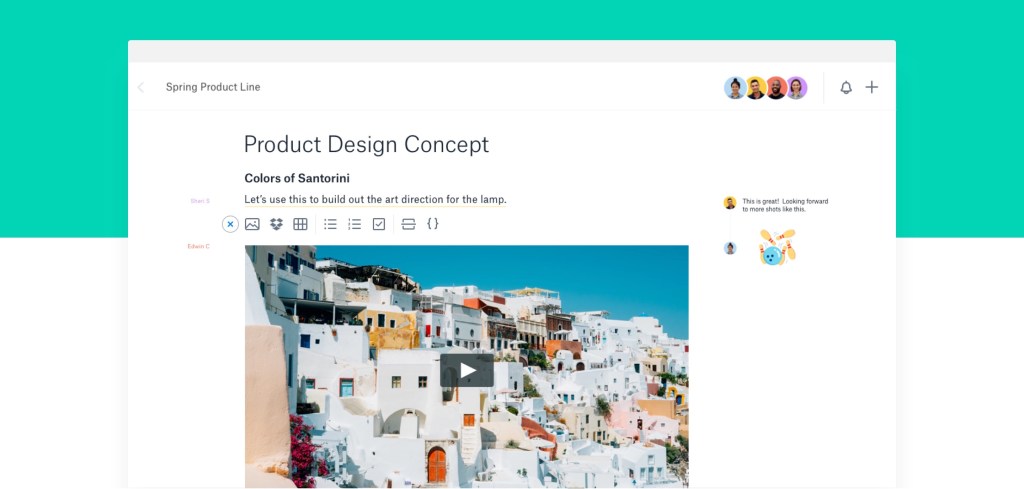
Dropbox said today that it is rolling out Paper — its note-taking app that it’s emphasizing is a tool that’s built for managing workflow as well — globally.
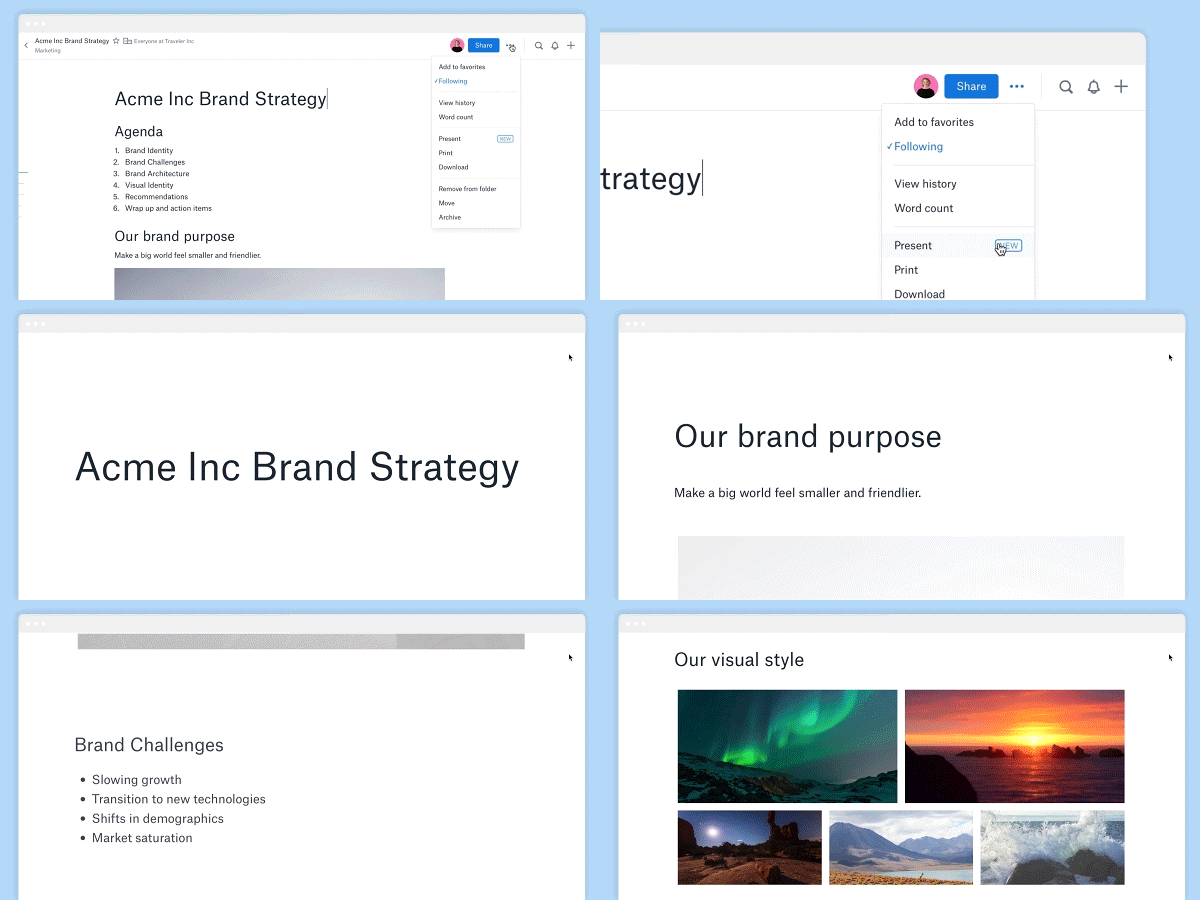
In addition to the regular launch of Paper, the company said that users will also be able to automatically generate presentations and run them through Paper in their browsers. Radhakrishnan said that users were basically taking parts of Paper documents and pasting them into presentation applications given that the documents had turned into large lexicons of a project for meetings. Dropbox also said Paper has been localized into 21 languages.
“The thing that Dropbox Paper does well is that it really supports modern workflows really well,” Dropbox group product manager Kavitha Radhakrishnan said. “We re-imagined the experience from the bottom up. We wanted to make sure it works not just from creation to views, but beyond that. We want it to support all phases of the creative process.”
The service was also interestingly being widely used as a way to manage and assign tasks, Radhakrishnan said. So the company also built in a way to do that. The process can boil down to a simple checklist, and all of this has sort of morphed Paper into a sort of record of the entire workflow for a project including assets, notes and timelines.
Paper came out in a closed beta in the second quarter last year, and then opened as a public beta in the third quarter. In August, the company said it would roll out mobile versions of Paper. As it’s inched closer to launch, both Google and Salesforce in some ways have thrown their weight behind collaborative tools in a similar vein to Paper. For Dropbox, the hope is that its strategy of religiously tracking user behavior will be part of the edge that keeps them ahead of those larger companies.
As Paper adds more and more of these features, there’s always the risk of feature-creeping the app. For Dropbox, some of these additions — like a presentation mode — may seem like they come out of nowhere and that Paper could quickly turn into some frankenstein that you might see from larger companies. Radhakrishnan said Dropbox does an enormous amount of user testing, but the company has to strike a balance between what users are demanding and keeping the app simple.
Disrupt 2026: The tech ecosystem, all in one room
Your next round. Your next hire. Your next breakout opportunity. Find it at TechCrunch Disrupt 2026, where 10,000+ founders, investors, and tech leaders gather for three days of 250+ tactical sessions, powerful introductions, and market-defining innovation. Register now to save up to $400.
Save up to $300 or 30% to TechCrunch Founder Summit
1,000+ founders and investors come together at TechCrunch Founder Summit 2026 for a full day focused on growth, execution, and real-world scaling. Learn from founders and investors who have shaped the industry. Connect with peers navigating similar growth stages. Walk away with tactics you can apply immediately
Offer ends March 13.
“It’s not just about listening to user feedback,’ she said. “As we do user research we look into true pain points and design internally to try out new ways of thinking through scenarios. We prioritize and iterate and add those to the product. It is a balance, but it’s something we take very seriously. We want to make sure one of our main philosophies, simple but powerful, that we maintain that.”
Paper is entered into a kind of precarious market. Salesforce bought Quip for $750 million late last year. While Paper was already competing with Quip in some ways, Salesforce’s major acquisition of the company signaled that it was quickly looking to broaden its enterprise toolkit. That means that Dropbox will likely come more into direct competition in this space with Salesforce, which may be able to throw more resources at the problem than Dropbox can.
Dropbox has been under pressure on all sides to figure out an enterprise strategy going forward. It has to woo major clients away from larger companies like Microsoft and Box with some kind of differentiated service. Today, for example, it also made its continuous synchronization service Smart Sync — which allows businesses to essentially treat files stored in the cloud as normal files on their computers without having to locally store them — available for Dropbox Business and enterprise customers.
All these incremental pieces are starting to reveal, over time, Dropbox’s strategy to justify its $10 billion valuation from its previous financing round years ago. Though it probably won’t achieve that if it ended up going public — given the tough environment and comparable companies that it competes aggressively with — it still has to convince the world that it’s going beyond just simple cloud storage.