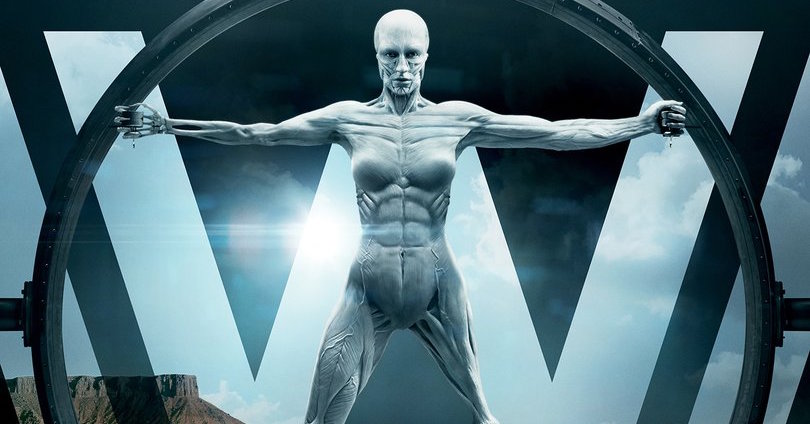
What if you could shoot or screw whoever you wanted without consequences? Would you feel bad about your decisions? Would you pity your victims, even if their digital memories were wiped clean? HBO dives into the heady, murky depths of virtual reality ethics with its new show Westworld, premiering October 2nd.
Based on Jurassic Park author Michael Crichton’s 1973 book, Westworld revolves around an amusement park that seems like VR but is actually a real place populated by rich human “guests” and human-looking AI robot “hosts”.
It’s the Grand Theft Auto video game set in the Wild West. Guests can do anything they like, from getting into gun fights to visiting the brothel, and they supposedly can’t be hurt by the hosts. But when these bots start deviating from their programming and the theme park’s corporate owners start losing control, the boundaries between real and fake blur.
What was originally written as science fiction has become uncannily similar to science fact. And while today’s virtual reality companies shy away from the philosophical questions they’re inevitable posing to us all, Westworld boldly confronts them. In one of the first scenes, the show exposes how a lack of accountability can spiral into mayhem and sexual violence.
“It was a chance to tell a frontier story on two levels” says Lisa Joy Nolan, one of the show’s creators. Westworld links the manifest destiny pioneers of the 1800s with tomorrow’s pioneers of technology. “Now science is both catching up with the imagination and exceeding it. It’s an iterative relationship.”
Her husband and co-creator Jonathan Nolan insists that “I don’t think there’s a message or that the show is necessarily teaching anything. It’s first and foremost entertainment but I hope we’re asking interesting questions.”
Disrupt 2026: The tech ecosystem, all in one room
Your next round. Your next hire. Your next breakout opportunity. Find it at TechCrunch Disrupt 2026, where 10,000+ founders, investors, and tech leaders gather for three days of 250+ tactical sessions, powerful introductions, and market-defining innovation. Register now to save up to $400.
Save up to $300 or 30% to TechCrunch Founder Summit
1,000+ founders and investors come together at TechCrunch Founder Summit 2026 for a full day focused on growth, execution, and real-world scaling. Learn from founders and investors who have shaped the industry. Connect with peers navigating similar growth stages. Walk away with tactics you can apply immediately
Offer ends March 13.
Yet the idea that we must raise these questions, no matter how uncomfortable, before their answers creep up on us is an important message itself. We can’t always see the ideas we embed in what we create without critical examination.
“Everyone has implicit bias…You come from things with a set perspective. And whether you’re talking about creation like you create a child, or you’re creating a work of art, or you’re creating a work of technology, your implicit bias is a transferable thing” Lisa concludes. “What is the answer to that? I think you counteract implicit biases with discourse.”