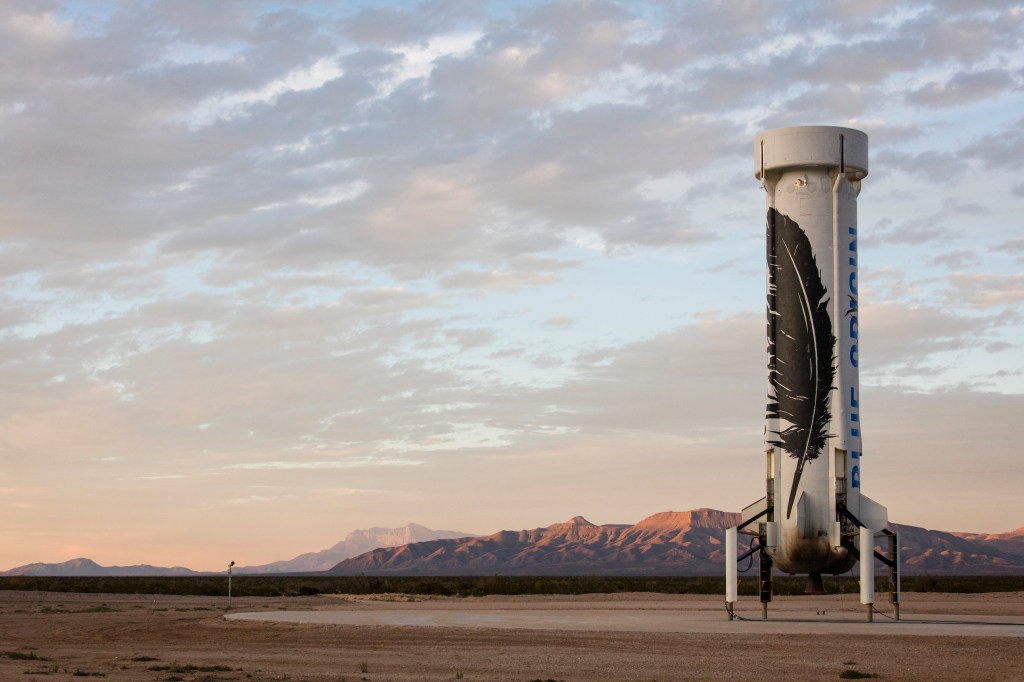
Without any notice, Blue Origin made history once again when they completed a successful launch and landing of a suborbital rocket yesterday. What made this flight particularly notable was that they used the same rocket that had been launched into space on a flight in November.
The recovered New Shepard rocket launched from Blue Origin’s test site in West Texas, brought a capsule to space at an altitude of 101.7 kilometers, and then both the booster and the capsule returned safely back down to the ground. The Karman line, the generally agreed upon line of space, is held at 100 kilometers.
The booster was directed back to the Earth where it made a propulsive soft landing. The capsule returned at a different location using 3 large parachutes and retro-thrust propulsion to slow its descent.

Video of the launch was titled “Launch. Land. Repeat.” A simple concept, but a truly revolutionary strategy for the rocket industry that is just now taking shape with companies like Blue Origin and SpaceX leading the way.
In November, Blue Origin performed a similar suborbital launch and landing with the New Shepard rocket to an altitude of 100.5 kilometers.
Disrupt 2026: The tech ecosystem, all in one room
Your next round. Your next hire. Your next breakout opportunity. Find it at TechCrunch Disrupt 2026, where 10,000+ founders, investors, and tech leaders gather for three days of 250+ tactical sessions, powerful introductions, and market-defining innovation. Register now to save up to $400.
Save up to $300 or 30% to TechCrunch Founder Summit
1,000+ founders and investors come together at TechCrunch Founder Summit 2026 for a full day focused on growth, execution, and real-world scaling. Learn from founders and investors who have shaped the industry. Connect with peers navigating similar growth stages. Walk away with tactics you can apply immediately
Offer ends March 13.
The New Shephard vehicle will be used to bring tourists and researchers into suborbital space, competing with similar rides offered by Richard Branson’s company, Virgin Galactic.
In a blog post on the company’s website, Blue Origin founder Jeff Bezos explained that a few hardware replacements and software adjustments were necessary after their first New Shepard launch. In addition to replacing the crew capsule parachutes and the booster’s pyro igniters, the Blue Origin team made a “noteworthy” software improvement related to landing on the pad.
Back in December, SpaceX successfully launched and landed their Falcon 9 rocket in an orbital mission to space. Many, including Elon Musk himself, were quick to point out that SpaceX’s rocket recovery was slightly different than Jeff Bezos’ rocket recovery.
Getting to space needs ~Mach 3, but GTO orbit requires ~Mach 30. The energy needed is the square, i.e. 9 units for space and 900 for orbit.
— Elon Musk (@elonmusk) November 24, 2015
It’s unlikely, however, that we’ll be able to watch SpaceX’s recovered Falcon 9 fly again. Musk has stated that “I think we’ll probably keep this one on the ground. Just, it’s kind of unique, it’s the first one we’ve brought back.”
Bezos obviously didn’t share that mindset and it ended up paying off. Recovering a rocket is one (completely amazing) thing, but showing that you can actually use that rocket again is another. What good is a recovered rocket if you can’t use it again?
“Our Vision: Millions of people living and working in space. You can’t get there by throwing the hardware away.” – Blue Origin
Bezos noted that their New Shephard vehicle is the smallest booster that they will build. Larger, orbital vehicles are next on the Blue Origin to-do list.
“We’re already more than three years into development of our first orbital vehicle. Though it will be the small vehicle in our orbital family, it’s still many times larger than New Shepard. I hope to share details about this first orbital vehicle this year.” – Jeff Bezos
Reliability is everything in the rocket industry where companies are betting millions, sometimes billions, of dollars on the expectation that their ride to space will be safe and seamless. The stakes are even higher when you have humans on board. All companies involved in the rocket reusability game still have a ways to go to prove that they can consistently launch recovered rockets.
But if the past three months are any indicator, Blue Origin and SpaceX are well on their way to changing the rocket industry as we know it.