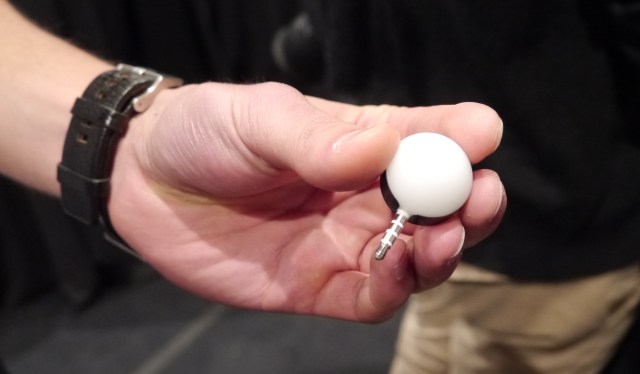
Meet Lumu: a digital light meter for photographers that plugs into the iPhone’s headphone jack as a smaller and smarter replacement for traditional analogue light meters. It’s used in conjunction with Lumu’s app — being demoed in prototype here at hardware alley at Disrupt NY — to help photographers figure out the best camera settings for their current location.
Lumu is not going to help you take better photos on your iPhone — it’s a tool for standalone cameras that have ISO, aperture and shutter speed parameters that can be manually set. The startup, which hails from Slovenia in Europe, plans to kick off a Kickstarter funding campaign in about a month. The Lumu device will cost $99.
“It’s the world’s smartest light meter,” says co-founder Benjamin Polovic. “The existing light meters are large, bulky and very expensive. With Lumu, the main processing is done on the iPhone, so we use the iPhone’s power. It also doesn’t use any batteries, it’s powered from the iPhone.
“You take your iPhone or your iPod and plug it in and it’s going to recognise it, and it sets all of the parameters for your unique environment. So you put in your ISO that you use in your film or your digital camera, the aperture you want to use and then it calculates the time.”
The photographer then needs to manually input the suggested settings into their camera but Polovic says the group is thinking about making a Bluetooth dongle so settings can be wirelessly sent to a digital camera. “We’re excited to get some ideas from Kickstarter when the campaign launches,” he added.
As well as showing the light level and exposure value for the current lighting conditions, the app lets users store pre-sets for individual geotagged locations so they can easily revisit them later. It will also include an auto mode, and a filter-style feature that will tell users how to achieve effects such as bokeh (background blur). 
Polovic said Lumu’s hope is to inspire more people to start digging down into their camera settings. “We love photography, we want to make it better, we want to introduce it to people who don’t necessarily know how to use cameras because they are quite complex. We want to make it simple,” he says.
Disrupt 2026: The tech ecosystem, all in one room
Your next round. Your next hire. Your next breakout opportunity. Find it at TechCrunch Disrupt 2026, where 10,000+ founders, investors, and tech leaders gather for three days of 250+ tactical sessions, powerful introductions, and market-defining innovation. Register now to save up to $400.
Save up to $300 or 30% to TechCrunch Founder Summit
1,000+ founders and investors come together at TechCrunch Founder Summit 2026 for a full day focused on growth, execution, and real-world scaling. Learn from founders and investors who have shaped the industry. Connect with peers navigating similar growth stages. Walk away with tactics you can apply immediately
Offer ends March 13.
The startup has been developing Lumu for about four to five months, according to Polovic. Down the line, it plans to launch an SDK so developers can create other apps using the light sensor — giving the example of an app that wakes the iPhone’s owner when it starts getting light, for instance.