

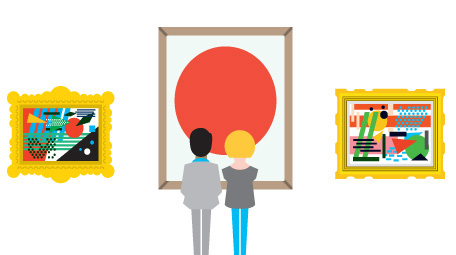
I keep seeing this topic push up about how data is affecting creativity. Some say we are losing our sense of narration and storytelling. It’s not this at all. We are just experiencing a shift that other civilizations have faced when the traditional means for storytelling transform to give a sense of the changing times facing society.
That does not mean a rejection of the narrative form. The ancient Greeks developed a rich oral tradition for telling stories. Out of that they created a common language, which formed the foundation for fables, legends and myths.
Now we see that data, shaped by software, creates a space to tell stories in new ways. Narrative methods to express our imagination will change as techniques emerge that allow us to use programming languages to carry on what we know for the next generations.
Om Malik says it’s this sense of data storytelling that will become so important. Today, he explains, data is used as a blunt instrument. The ones that use data more effectively well remind of us how we relate to each other.
Cloudera Co-Founder and Data Scientist Jeff Hammerbacher said on the Charlie Rose show earlier this month that it’s not that “numerical” imagination” is better than using “narrative” imagination. It’s just that now, for the first time in thousands of years, we need to think more about using data analytic methods for developing stories.
For example, Hammerbacher is working as an assistant professor at Mount Sinai Medical Center in New York, developing a storage and data analysis infrastructure. Like Malik, Hammberbacher said it’s how we find ways to pair data that will give us insights. For instance, finding ways to integrate genetic databases and electronic health records that tell a story that both physicians and patients understand.
Hammerbacher recounted a story to Rose about a lump that appeared on his chest. The doctor examined it and sent him to another doctor. Hammebacher asked the question: “Don’t you want to quantify what is in my body?” He followed by saying the amount of insight we get into a server at Facebook is greater than we have about our own bodies. The ones who can quantify our own human data and network it will give society new ways to explain who we are through dimensions we never imagined.
Disrupt 2026: The tech ecosystem, all in one room
Your next round. Your next hire. Your next breakout opportunity. Find it at TechCrunch Disrupt 2026, where 10,000+ founders, investors, and tech leaders gather for three days of 250+ tactical sessions, powerful introductions, and market-defining innovation. Register now to save up to $400.
Save up to $300 or 30% to TechCrunch Founder Summit
1,000+ founders and investors come together at TechCrunch Founder Summit 2026 for a full day focused on growth, execution, and real-world scaling. Learn from founders and investors who have shaped the industry. Connect with peers navigating similar growth stages. Walk away with tactics you can apply immediately
Offer ends March 13.
Hammerbacher and Malik have views from different spaces across the information spectrum. But they both point to a new reality that will require us to think much differently about how we imagine our world and the data that is now far visible than ever before.
