In the wake of Twitter’s acquisition of crash-reporting tool Crashlytics, there’s been a renewed interest in and awareness of the bug tracking space. Sentry, a year-old service which also tracks application errors in web and mobile apps, is poised to take advantage of that interest, and is today debuting a redesigned version of its hosted platform, which now includes more integrations with external services like GitHub and HipChat, improved navigation, collaboration features, and more.
The service, created by Disqus’s Director of Design Chris Jennings and Lead Engineer David Cramer, initially served as an internal tool for exception logging in Django applications at Disqus, where the two still work full-time. But the company used it and relied on it so much, they decided to open source the project around two years ago in order to share it with the community. Since then, some 50 other developers have contributed at least a line of code to Sentry’s GitHub page, and the tool has grown to support many other popular languages, like Python, PHP, Java, Ruby, Node.js, and JavaScript.
Although the open source version was popular, the team began fielding requests for a hosted service after its debut. “The cost of running and deploying your own server just to monitor the errors maintenance in your application for a lot of users isn’t really practical – there’s a lot of and cost involved with maintenance and upkeep,” Jennings explains. So around a year ago, Sentry debuted its hosted version, with tiered pricing based on the number of exceptions an application throws.
The service has already been adopted by several big-name tech companies and startups, including Rdio, Pinterest, Path, Mozilla, as well as Disqus. Somewhat ironically, Twitter’s Vine also used Sentry during its launch despite the fact that its parent just bought a Sentry competitor. (Update: Vine’s Alex DeJarnatt says, “we use Sentry for our backend and Crashlytics for iOS.”)
Today, there are nearly 500 paying customers for the hosted version, and Sentry is “making good money.” (Jennings declined to provide revenue numbers, however.) He says Sentry is growing at a rate of 10 percent per month, it’s profitable, and given its current nature as a side project to the founders’ work at Disqus, they have no plans to raise any outside funding at this time. Since the Crashlytics acquisition, traffic to Sentry has also jumped by 10 percent, Jennings says.
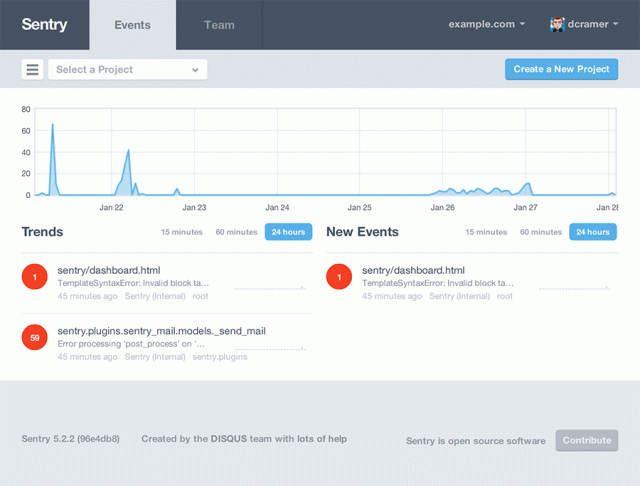
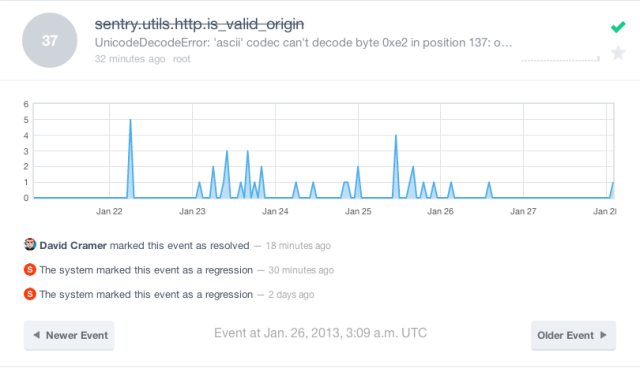
With today’s relaunch, the focus has been on improving the user interface and design, and adding more collaboration features and integration options. The new version offers a more consistent look, better navigation, and more. It now offers an “activity stream” view which shows details of how an event has changed over time, and who on a team is resolving the bug, for example.
Disrupt 2026: The tech ecosystem, all in one room
Your next round. Your next hire. Your next breakout opportunity. Find it at TechCrunch Disrupt 2026, where 10,000+ founders, investors, and tech leaders gather for three days of 250+ tactical sessions, powerful introductions, and market-defining innovation. Register now to save up to $400.
Save up to $300 or 30% to TechCrunch Founder Summit
1,000+ founders and investors come together at TechCrunch Founder Summit 2026 for a full day focused on growth, execution, and real-world scaling. Learn from founders and investors who have shaped the industry. Connect with peers navigating similar growth stages. Walk away with tactics you can apply immediately
Offer ends March 13.
The new “teams” feature introduces a dashboard-like interface which serves as the hub for managing projects, and an inline event browser let developers move between similar events quickly. On the integrations side, Sentry now works with GitHub, Campfire, HipChat, Grove.io, Bitbucket, JIRA, IRC, Pivotal Tracker, Sprint.ly and Trello.

Going forward, the founders are thinking about how they can expand Sentry beyond bug tracking.
“Historically, we’ve been a developer tool, but a big shift we’re making with our thinking and our progress with maintaining and building Sentry is that we have a bit of information – more than say, someone like Intercom or Mixpanel – we have the data about the users who are hitting the errors in your application,” Jennings explains. “We’ve recently started playing with servicing this information. Soon, we’re going to start tracking and presenting actual users, and giving you tools to recover these bad users experiences,” he adds.
He says the company is discussing integrating with Intercom for this, too, and that the feature will go live as soon as this month. Interested users can sign up for the hosted version of Sentry here, or try it free for a 7 days.