My favorite product at CES isn’t an 8K Ultra High Definition Connected Smart TV with Glasses-Free 3D. It’s not a Smart Oven with Dual-Meal Cooking Technology and an Integrated App Ecosystem that includes Spotify and Twitter. It isn’t a Chest-Hugging Digital Activity Band designed to quantify your self, with sensors to monitor your Heart Rate, Sweat Level, Air Cleanliness Level, Blood Alcohol Level, and Average Flatulence while navigating through your day.
Instead, it is something you put in your mouth. Something that will help you lose weight. Something that will improve your digestion, will make you feel good about yourself.
It’s a fork.
By now you’ve probably heard about the HAPIfork. It’s been covered thousands of times in the media, and even caught the attention of Stephen Colbert, who featured the device in his “Wag of the Finger” segment.
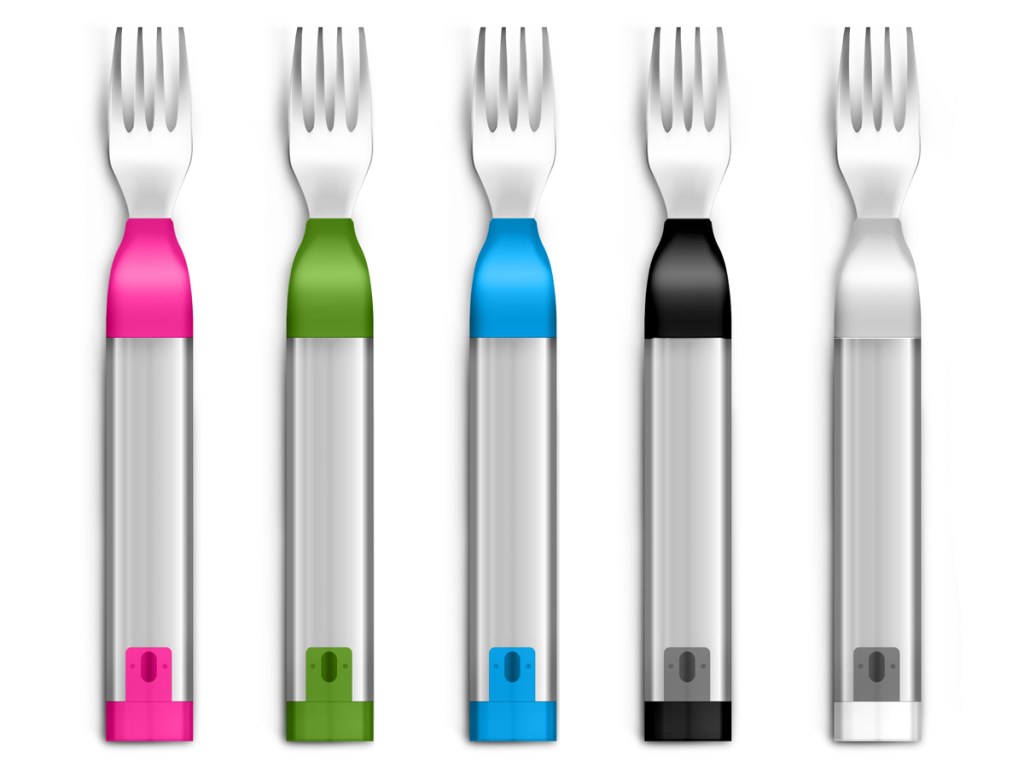
If you somehow haven’t heard about it, HAPIfork is a “high-tech” fork designed to monitor how quickly you’re eating. And if you are eating too quickly, it will vibrate in your mouth to tell you to slow your roll. It also records all this data and allows you to connect it to your computer and upload it to the cloud, so you can track your progress over time.
There’s been no shortage of jokes lobbed at the HAPIfork, as you’ve seen from the Colbert video above. The overwhelming consensus seems to be that the technology in the fork is solving a first-world problem, and that, people who really want to lose weight by eating more slowly should just, uh, eat more slowly.
The HAPIfork also has landed right square in the middle of an explosion of devices meant to measure, monitor, track, and quantify your life. At CES we’ve seen any number of wristbands, dongles, heart monitors, motion sensors, and other various wearable quantified self gear. When you can measure your heart rate, the number of steps you’ve taken, and general activity level, something as small as how many seconds you’re waiting in-between bites seems a little less important.
Disrupt 2026: The tech ecosystem, all in one room
Your next round. Your next hire. Your next breakout opportunity. Find it at TechCrunch Disrupt 2026, where 10,000+ founders, investors, and tech leaders gather for three days of 250+ tactical sessions, powerful introductions, and market-defining innovation. Register now to save up to $400.
Save up to $300 or 30% to TechCrunch Founder Summit
1,000+ founders and investors come together at TechCrunch Founder Summit 2026 for a full day focused on growth, execution, and real-world scaling. Learn from founders and investors who have shaped the industry. Connect with peers navigating similar growth stages. Walk away with tactics you can apply immediately
Offer ends March 13.
But that’s why I love it. The HAPIfork focuses on a singular problem, rather than trying to do too much by providing a view into your health as a whole. And by doing so, it makes that problem actually approachable.
Not just that, but it’s actually actionable. It’s great that the Nike Fuelband, Fitbit, Fitbug, or any of the other activity-monitoring devices can track how much I’m moving around during the day and provide me detailed analytics over time. But they’re not going to put my running shoes on for me. They’re not going to get me out of the door, except maybe by shaming me over weeks of staring at my inactivity. Not so with the HAPIfork. Every bite is a potential teaching experience.
The importance of the fork is even more significant when you consider the broader context of CES. The world probably doesn’t need a 120″ Ultra HD Touchscreen Display with convertible stand so that you can swivel it down and play digital air hockey. While technology for the sake of it is cool and all, that’s ultimately not going to change the world for the better.
With an obesity epidemic underway, more residents in the U.S. could probably use a device that literally tells them to put down the goddamn fork. Still, there are a lot of things that HAPIlabs could do to improve the fork over time. Like, for instance, adding wireless connectivity, rather than connecting via USB. It could get thinner, so that it doesn’t look so much like a kid’s training tool. But I personally can’t wait for the fork to actually become available and test it out myself.