Following five months of work, location-based Q&A platform Localmind is launching its biggest release today since its original debut with the arrival of Localmind 2.0. The newly revamped platform represents a shift for the company, which, as you may remember, sits on top of Foursquare, allowing you to pose questions in real-time to those checked in at local venues.
Today, the company is expanding its focus by allowing users to ask questions of local “experts,” even if they’re not currently checked in to a given location. However, answers can still be replied to in real-time, preserving the sense of immediacy found in the original product.
The problem with Localmind’s previous version, as anyone who used the product could tell you, is that the people checked in to a given location may not necessarily be the best ones to answer your question. While, sure, they could tell you whether the bar was crowded or whether the tuna was the special for the night, the limited use cases (and, frankly, the need) for this feature limited the product’s growth. Outside of buzzy events like SXSW where Localmind first took off among the early adopter crowd, the real-world need to ping someone with immediate questions about local businesses was far less pressing.
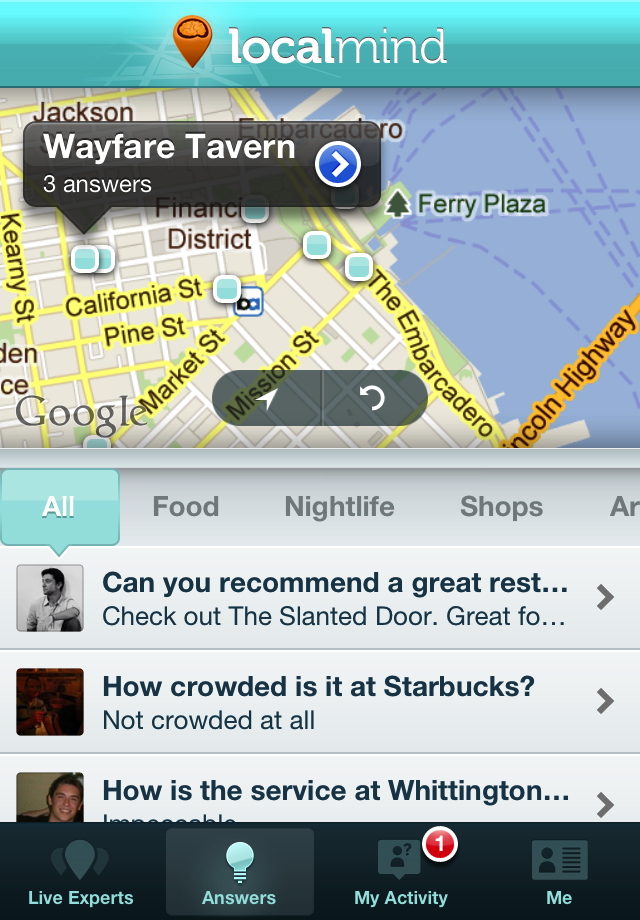 What people more often want to know are broader questions than those relating to the current situation found in a given venue. They want to know if it’s true that this food cart has the best tacos, or if that French place is family-friendly or more often frequented by couples having a quiet night out. They want to know about parking situations, outdoor activities and general “things-to-do” type recommendations.
More importantly, they want answers they can actually trust. The latter is the hardest part of the equation, and something that user ratings and reviews sites have always struggled with. Does that unhappy customer have an ax to grind? Was that review or tip slyly posted by the business owner himself?
Although Localmind is not a user review site per se, it offers some similarities as it also relies on crowdsourced opinions as its main value driver. So, in order to make the A’s of Localmind’s Q&A’s more trustworthy, the service uses a suite of algorithms to surface experts based on their actual activities – going out, checking in, leaving tips, etc. – as opposed to the Facebook graph of “likes.”
Over time, Localmind learns who’s an expert in what, and what types of questions they prefer to answer, then routes those questions appropriately. Today, the Localmind experts answer 90% of questions, typically in three minutes time.
Disrupt 2026: The tech ecosystem, all in one room
Your next round. Your next hire. Your next breakout opportunity. Find it at TechCrunch Disrupt 2026, where 10,000+ founders, investors, and tech leaders gather for three days of 250+ tactical sessions, powerful introductions, and market-defining innovation. Register now to save up to $400.
Save up to $300 or 30% to TechCrunch Founder Summit
1,000+ founders and investors come together at TechCrunch Founder Summit 2026 for a full day focused on growth, execution, and real-world scaling. Learn from founders and investors who have shaped the industry. Connect with peers navigating similar growth stages. Walk away with tactics you can apply immediately
Offer ends March 13.
While the new focus on a broader reacher is an important step for the company, there’s still the potential issue of growing the service’s expert network. For Localmind to prove its value outside of dense urban areas like NY, or tech hotspots like San Francisco, it may need to find ways to surface answers through less real-time means.
The new version of Localmind is live in the iTunes App Store here.
[youtube http://www.youtube.com/watch?v=EGJQzmqjK8Q?feature=player_embedded&w=640&h=360]