

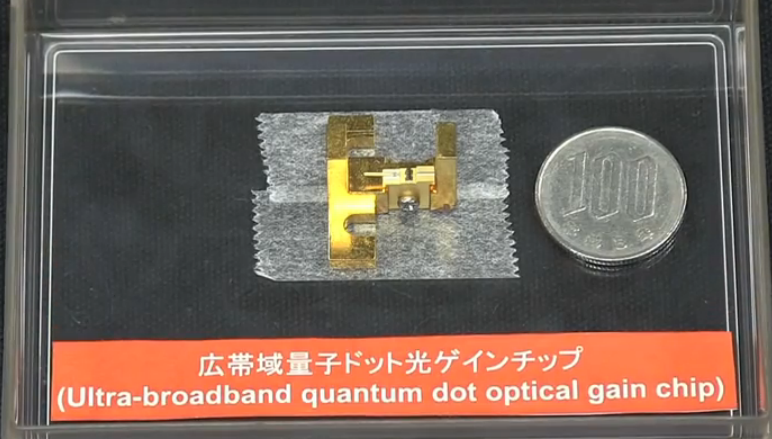
A team of researchers at the Photonic Network Research Institute of Japan’s National Institute of Information and Communications Technology (NICT) has developed a new light source technology that might pave the way to some pretty spectacular applications in the future.
The core piece of the technology are “high-quality” quantum dots, tiny nano particles, that boast higher stability and optical frequency than those created the conventional way.
By using the so-called “Sandwiched sub-nano separator structure”, NICT says their quantum dots can be utilized in optical frequency bands that are about 70 Thz wide, which is about seven times wider than the 10Thz of conventional frequency bands currently offer.
NICT also says that because this new wavelength band can permeate human skin, their technology could also be used in bio-imaging, for example to shoot high-resolution photos of new molecules in cells.

NICT explains their light source technology:
Usually when you fabricate quantum dots, you grow crystalline quantum dot particles, in nanometer size, on the semiconductor surface. But this time, we’ve formed a very thin layer, less than one nanometer thick, between the surface and the dots. By adding just this nanometer layer, we’ve be able to form high-quality quantum dots, without aggregation structures, at very high density.
Disrupt 2026: The tech ecosystem, all in one room
Your next round. Your next hire. Your next breakout opportunity. Find it at TechCrunch Disrupt 2026, where 10,000+ founders, investors, and tech leaders gather for three days of 250+ tactical sessions, powerful introductions, and market-defining innovation. Register now to save up to $400.
Save up to $300 or 30% to TechCrunch Founder Summit
1,000+ founders and investors come together at TechCrunch Founder Summit 2026 for a full day focused on growth, execution, and real-world scaling. Learn from founders and investors who have shaped the industry. Connect with peers navigating similar growth stages. Walk away with tactics you can apply immediately
Offer ends March 13.

This video, shot by Diginfo TV in Tokyo, provides more insight (in English):
[youtube=http://www.youtube.com/watch?v=KlgxX3ZP3j0&w=560&h=315]

