

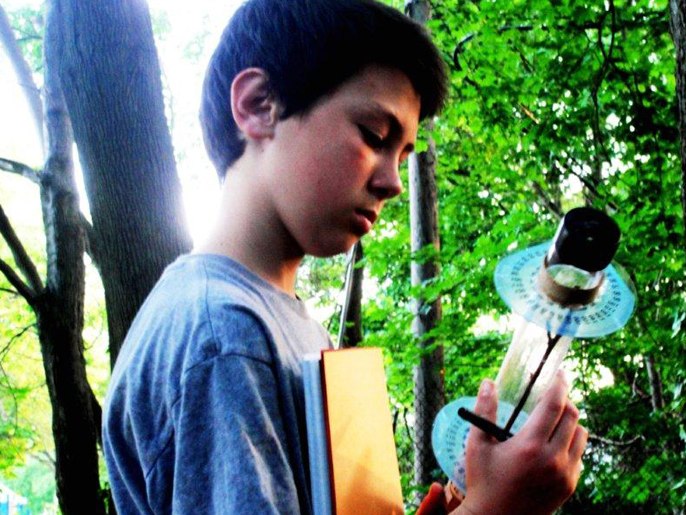
When it comes to renewable energy solutions, sometimes nature has the best ideas. That was 13-year-old Aidan Dwyer’s conclusion after a wintry hike in New York’s Catskill Mountains, a trip that inspired him to build a unique and effective solar array design.
Dwyer observed patterns in the trees and, after further research and contemplation, realized the branches matched up with the Fibonacci sequence, a mathematical pattern found throughout nature, such as in falcon flight paths, nautilus shells and ratios within the human body.

Dwyer speculated that this pattern aided the trees in photosynthesis and tested his hypothesis by building a miniature tree-shaped solar array. The project won him a 2011 Young Naturalist Award from the American Museum of Natural History.

The 7th grader describes his experiments in a detailed essay:
I designed and built my own test model, copying the Fibonacci pattern of an oak tree. I studied my results with the compass tool and figured out the branch angles. The pattern was about 137 degrees and the Fibonacci sequence was 2/5. Then I built a model using this pattern from PVC tubing. In place of leaves, I used PV solar panels hooked up in series that produced up to 1/2 volt, so the peak output of the model was 5 volts. The entire design copied the pattern of an oak tree as closely as possible.
Disrupt 2026: The tech ecosystem, all in one room
Your next round. Your next hire. Your next breakout opportunity. Find it at TechCrunch Disrupt 2026, where 10,000+ founders, investors, and tech leaders gather for three days of 250+ tactical sessions, powerful introductions, and market-defining innovation. Register now to save up to $400.
Save up to $300 or 30% to TechCrunch Founder Summit
1,000+ founders and investors come together at TechCrunch Founder Summit 2026 for a full day focused on growth, execution, and real-world scaling. Learn from founders and investors who have shaped the industry. Connect with peers navigating similar growth stages. Walk away with tactics you can apply immediately
Offer ends March 13.
The design generated up to 50% more power than the model of a traditional solar installation during periods of low sunlight. The individual solar panels’ various angles help the array capture light even when the sun is very low in the sky. And, since they don’t lie flat, many of the panels are also less affected by shade and snow.
At this point, Dwyer’s design a backyard experiment, but perhaps in the future we’ll see roof gardens planted with solar tree arrays.
Images courtesy of the American Museum of Natural History Musuem.

