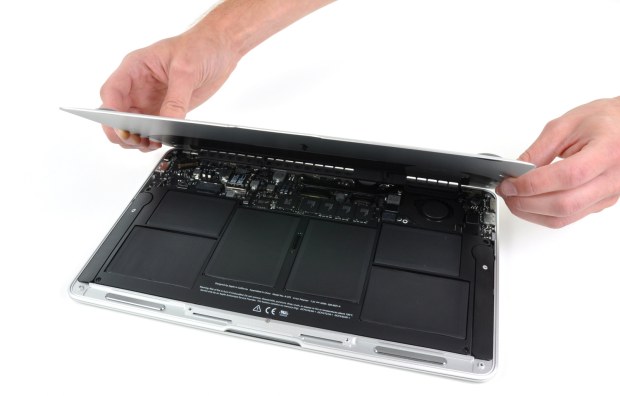
In classic iFixit fashion, the latest Apple laptop has been torn to pieces a mere day after its release event. How exciting! Now we get to find out how Apple managed to cram so much of 2007’s technology into that gorgeous case.
Unsurprisingly, Apple has made the new MacBook Air nigh-impossible to service on your own. Not only is the interior secured by five-sided Torx T5 screws, but most of the parts are so customized (not to say obscure) that you’d be unable to find them in even the most extensive part store.
Particularly notable is the storage array, which was tipped as being a unique concoction:
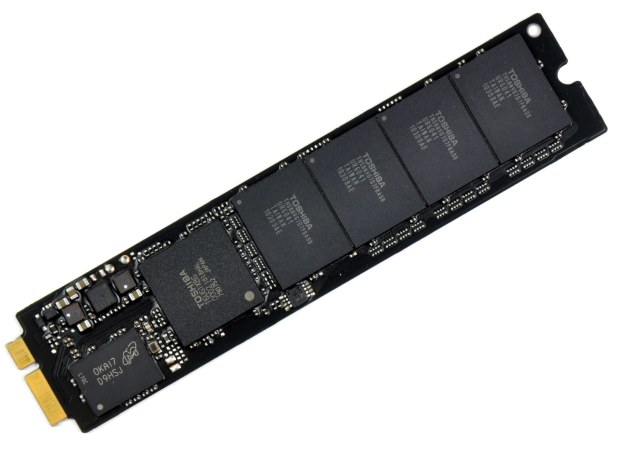
A series of Toshiba flash chips (nanometerage unknown), as seen in other SSD drives, but with a layout suitable for Apple purposes. It’s really not that special; it uses a common T6UG1XBG SSD controller, which is found in many other drives. The only real difference between this Apple drive and, say, a Kingston one, is that the Apple one isn’t a standalone component wrapped in a 2.5″ enclosure.
Other space-saving techniques are the usual Apple tricks of sandwiching boards together, turning components like Tetris pieces, and so on.
As you can see, by far the largest component is the battery cells, which have been split and spread out for maximum balance and heat dispersal. This thing is going to get warm, especially when charging. Remember to use a pillow or lap desk if you’re going to do some couch computing, or else be at risk for toasted skin syndrome.
Disrupt 2026: The tech ecosystem, all in one room
Your next round. Your next hire. Your next breakout opportunity. Find it at TechCrunch Disrupt 2026, where 10,000+ founders, investors, and tech leaders gather for three days of 250+ tactical sessions, powerful introductions, and market-defining innovation. Register now to save up to $400.
Save up to $300 or 30% to TechCrunch Founder Summit
1,000+ founders and investors come together at TechCrunch Founder Summit 2026 for a full day focused on growth, execution, and real-world scaling. Learn from founders and investors who have shaped the industry. Connect with peers navigating similar growth stages. Walk away with tactics you can apply immediately
Offer ends March 13.
The batteries themselves total 35 watt-hours; a little calculation puts the 11.6″ MacBook Air’s power consumption at a rather low 7W when active, and 50 milliwatts when sleeping. You can thank LED backlighting, a low-voltage processor, and solid-state storage for that.
All told, it’s a nice little piece of engineering. The 13″ version probably has a little more breathing room; I’m sure iFixit is logic-board deep in that one as well, and I look forward to seeing the differences.